Pages

Sunday, May 5, 2013

THE WORLD WE LIVE IN


Many spiritual teachers I've read say that we create our own reality - we create the world we live in by the way we view and react to it.  The book of Proverbs says, "As a man thinketh, so is he.  Jesus cautioned that if a man lusts after a woman in his heart, he has committed adultery.  I think that's because if a person dwells on a thought, they will eventually actually perform the action, making it into a reality.  So, saying we create our own reality is true - to a certain extent. 

I was stumped for a long time over this, because certainly a person living in a war-torn region did not create the war by their thoughts.  Starving people do not create famines.  Unemployed people do not create a lack of jobs. Domestic abuse victims do not create their situations.  Sick people do not create their diseases. I think we do create the world, the society, we live in - but collectively.  The action of one person does not create their whole world, because there are many other forces at work. But is is true that collectively we have created the world, the society, that we live in.

I so long for a world that works for everyone, where everyone is treated with respect, kindness, and compassion.  We have created the structures, the institutions, the systems, and the situations we have, and only we can change them.  But what can one person do?  The words and actions of one person CAN begin to change ideas and taken-for-granted ways of doing things!  One person's ideas and fresh ways of looking at situations can put a crack in the foundation of long established structures!  And, for me, that's a very exciting and empowering thought!


Sunday, March 24, 2013

COMPASSION FOR ALL

I recently discovered a wonderful new resource called Contemplative Journal.  From the site's description: "Wherever you may be on your spiritual journey, your ideas and beliefs are welcome here. This is a place where meaningful inquiry, sound scholarship, and non-conceptual experience blend seamlessly. Contemplative Journal boldly explores the wildest mysteries of the universe within the context of the daily lives of our readers.

Below is one of their first offerings, a heart-opening interview with Rabbi Rami Shapiro as he explores how the future of humanity lies at the intersection of compassion and contemplation.  From the interview: "Kindness cares for the other; in compassion, there is no other...When I'm being kind to you, it's like I'm one step up - you need some help, I'll be kind to you.  I'm in a position of power and the recipient has less power.  But in compassion, we meet at our brokenness...The Divine Reality is for everyone - all beings are our neighbors and we can love them all."


Saturday, March 16, 2013

Do Great Things: Understanding and Compassion Can Change the World

An inspirational presentation by Justin Rosenstein titled "Do Great Things: Understanding and Compassion" from the recent Wisdom 2.0 conference. The entire conference, featuring such speakers as Jon Kabat-Zinn, Jack Kornfield, Marianne Williamson, Dan Seigel, Joan Halifax, and Eckhart Tolle can be viewed free of charge here. 

Tuesday, January 1, 2013

CAN HEALTHY CHILD DEVELOPMENT SOLVE SOCIETY'S MOST PRESSING PROBLEMS?


Dr. Gabor Maté wrote the bestsellers Scattered: HowAttention Deficit Disorder Originates In the Realm of Hungry Ghosts: CloseEncounters with Addiction. The following article was adapted from an interview by Amy Goodman. Our society is suffering in a variety of ways - from widespread drug abuse to mass killings. Dr. Mate looks deeply to uncover the root of many of society's problems.

'Post-industrial' capitalism has destroyed the conditions for healthy childhood development. The hardcore drug addicts that I treat, are, without exception, people who have had extraordinarily difficult lives. The commonality is childhood abuse. These people all enter life under extremely adverse circumstances. Not only did they not get what they need for healthy development, they actually got negative circumstances of neglect. I don’t have a single female patient in the Downtown Eastside of Vancouver who wasn’t sexually abused, for example, as were many of the men--or abused, neglected and abandoned serially, over and over again. That’s what sets up the brain biology of addiction. In other words, the addiction is related both psychologically, in terms of emotional pain relief, and neurobiological development to early adversity.

AG: What does the title of your book mean, In the Realm of Hungry Ghosts?

GM: In the Buddhists’ psychology, there are a number of realms that human beings cycle through, all of us. One is the human realm, which is our ordinary selves. The hell realm is that of unbearable rage, fear, you know, these emotions that are difficult to handle. The animal realm is our instincts and our id and our passions.

Now, the hungry ghost realm, the creatures in it are depicted as people with large empty bellies, small mouths and scrawny thin necks. They can never get enough satisfaction. They can never fill their bellies. They’re always hungry, always empty, always seeking it from the outside. That speaks to a part of us that I have and everybody in our society has, where we want satisfaction from the outside, where we’re empty, where we want to be soothed by something in the short term, but we can never feel that or fulfill that insatiety from the outside. Addicts are in that realm all the time. Most of us are in that realm some of the time. My point really is, is that there’s no clear distinction between the identified addict and the rest of us. There’s a continuum in which we all may be found. They’re on it, because they’ve suffered a lot more than most of us.

AG: Can you talk about the biology of addiction?

GM: If you look at the brain circuits involved in addiction—and that’s true whether it’s a shopping addiction like mine or an addiction to opiates like the heroin addict—we’re looking for endorphins in our brains. Endorphins are the brain’s feel good, reward, pleasure and pain relief chemicals. They also happen to be the love chemicals that connect us to the universe and to one another.
Now, that circuitry in addicts doesn’t function very well, as the circuitry of incentive and motivation, which involves the chemical dopamine, also doesn’t function very well. Stimulant drugs like cocaine, crystal meth, nicotine and caffeine, all elevate dopamine levels in the brain, as do sexual acting out, extreme sports, workaholism and so on. The issue is, why do these circuits not work so well in some people, because the drugs in themselves are not surprisingly addictive. What I mean by that is that most people who try most drugs never become addicted to them. So, there has to be susceptibility there. The susceptible people are the ones with these impaired brain circuits, an impairment caused by early adversity, rather than by genetics.

AG: What do you mean, “early adversity”?

GM: Well, the human brain, unlike any other mammal, for the most part develops under the influence of the environment. And that’s because, from the evolutionary point of view, we developed these large heads, large fore-brains, and to walk on two legs we have a narrow pelvis. That means—large head, narrow pelvis—we have to be born prematurely. Otherwise, we would never get born. The head already is the biggest part of the body. Now, the horse can run on the first day of life. Human beings aren’t that developed for two years. That means much of our brain development, that in other animals occurs safely in the uterus, for us has to occur out there in the environment. And which circuits develop and which don’t depend very much on environmental input. When people are mistreated, stressed or abused, their brains don’t develop the way they ought to. It’s that simple. And unfortunately, my profession, the medical profession, puts all the emphasis on genetics rather than on the environment, which, of course, is a simple explanation. It also takes everybody off the hook.

AG: What do you mean, it takes people off the hook?

Sunday, November 4, 2012

NOTHING LOST/NOTHNG TO FEAR


It's been a long time since I posted anything, I guess I've been internally processing a lot of things that I've not been able to express. My offering for today is my vision of nonduality patched together from many different spiritual perspectives.   Incomplete as it may be, it helps me to keep my eyes on the big picture...and fills me with hope. So here goes: 

Everything on earth is transitory – it’s passing away.  It arises, and falls.  All the things we count on, even heaven and earth, shall pass away….  “All flesh is as grass, and all the glory of man as the flower of grass.  The grass withered, and the flower thereof falleth away, But the word of the Lord endureth forever” ( 1 Pet 1:24-25).  

Everything earthly is for a season.  Why do we let these things that pass away have dominion over us?  They come, they go.  But we cling to them…

Everything old is new again.  Nothing is ever really lost…it comes around again to manifest in the natural in a different form.  Nothing is ever worthless, it all has meaning and purpose, but that meaning and purpose is for a season…we just sojourn here… (Ecc. 1:9-11, 3:15).  

If we are all “passing away” but nothing is ever really lost of our essence, death really is swallowed up in victory.  We are a form through which the Life Essence (God) shines, albeit imperfectly.  Each one is different so that the glory of Life is manifested in a different way, from a different perspective, and temporarily (for a season). But when that body passes away, nothing of the essence is lost, because “Then shall the dust return to the earth as it was: and the spirit shall return unto God who gave it” (Ecc. 12:7). Since nothing is lost, there is no sting and nothing to fear

But the carnal mind (or insert your term of preference here: ego, devil, beast, conditioning, amygdala) is a fear-monger!  And it torments us continually…never shuts up!  That’s why many “relax” by watching TV, playing games – the carnal mind is engaged with something else and is not torturing us with worry and fear.  The carnal mind is the enemy who has taken us captive and drags us to hell to torture us.  “For to be carnally minded is death: but to be spiritually minded is life and peace” (Rom 8:6).  At the last trump (Rev 11:15) when the beast in us has been defeated and the mind of the Christ reigns in us, we will have rest.  For those who still worship the beast, “The smoke of their torment ascendeth up forever and ever (continually!) and they have no rest day or night” (Rev 14:9-11).  This happens in the very presence of the Lamb (v10), who is there all the time offering rest! 


It’s All Good…

There is an ancient story that tells of a student monk who began to laugh during group meditation and prayer.  The other students, horrified and embarrassed for the monk, hoped that he would stop laughing.  But his laughter grew louder and louder, until the other monks could not help but wonder what the teacher would do in the face of such irreverence.  But to the amazement of all the other monks, the teacher pronounced the laughing monk enlightened!  The monk laughed because he saw that everything is wonderful! Everything does work together for GOOD! It’s Divine play, in a way, but not as in a cruel game.  It’s a game in the sense that we shouldn’t take it so seriously, because nothing is ever really lost. There is really GOOD NEWS!  It’s only a game – there’s nothing to lose and nothing will ever be lost!  We take it all so seriously, and so cause all our own sorrow.  So we can begin to see that suffering and sorrow, although very real, are only for a season, and that everything is perfect and as it should be.  This is the peace that passes all understanding, when we see that there was never anything to fear.  

This is not to make light of the suffering in the world, just because we are in a large place and know that suffering is only for a season.  We need to work very hard to alleviate suffering, for suffering is very real.  

Right now, huge weather pattern changes are taking place, changes that could destroy millions and leave much of our planet frozen solid or an arid wasteland.  And I know it will be okay if even that happens…for nothing is ever lost.  It is all so very real and awe-inspiring; it is all also like a dream or a movie in which we are very involved.  Upon awakening, we will find ourselves in the heart of God.  Death happens, yes, but it has no sting.  There is nothing to fear.  We are on a great adventure, and we go back to where we came from.  What joy, freedom, peace, and rest is found in this knowledge:  nothing is ever lost and there is nothing to fear!

Thursday, June 21, 2012

ALLEVIATING SUFFERING


Suffering bothers me....it bothers me a lot. Speaking about suffering and enlightment, in this video Ken Wilber said, "It hurts more; but it bothers you less...When we taste the infinite Absolute of consciousness, the world is seen just as it is—radiant, perfect, and whole. The relative, however, does not cease to be. Quite the contrary, the pains and pleasures of our relative lives are intensified to an unimaginable degree. We have to give ourselves PLENTY of room to feel BOTH: The ABSOLUTE PERFECTION in everything that arises.
..And yet see ONE person starving and you will start crying so hard it will kill you.
" The more we become aware, the more it does hurt; the more acutely the pain and suffering of all those around us is felt.  At the same time, every manifestation we see around us is sacred and part of the Divine and so nothing is ever lost.  Suffering is of the utmost horror, but not to be taken too seriously because in the end nothing can be harmed at all and even death has no real sting.

From that perspective, we CAN watch everything unfold almost like watching a movie, for even though pain and suffering are very real, they are not the ultimate reality...

Enlightenment is realizing that we are all ONE, all manifestations of the Divine, all sacred, all holy.,,and to treat all "others" as such.  How much suffering in the world would be alleviated if we all treated everything as a part of ourselves?  This is why Jesus said, "As you did it unto the least of these, you did it unto me." Because we are all part of God.

Sunday, May 27, 2012

NATURE AND NONVIOLENCE

As I read the following article from one of my favorite authors and teachers, Thich Nhat Hanh, I thought it especially appropriate for Memorial Day. As we mourn those who have fallen in war, may we determine to be part of bringing into reality a world where violence does not take the lives of those we love and of fellow human beings.  Quotable: "A civilization in which we must kill and exploit others in order to live is not a healthy civilization. [...] To bring about peace within the human family, we must work for harmonious co-existence."   Namaste, ya'll....

Nature and Nonviolence

--by Thich Nhat Hanh (May 22, 2012)                                                          

                                                                                                                           Listen To Reading!


You don’t discriminate between the seed and the plant. You see that they ‘inter-are’ with each other, that they are the same thing. Looking deeply at the young cornstalk, you can see the seed of corn, still alive, but with a new appearance. The plant is the continuation of the seed.

The practice of meditation helps us to see things other people can’t see. We look deeply and we see that father and son, father and daughter, mother and son, mother and daughter, corn seed and cornstalk, have a very close relationship. That is why we should awaken to the fact, to the truth, that we inter-are. The suffering of one is the suffering of the other. [...] When we see that we and all living beings are made of the same nature, how can there be division between us? How can there be lack of harmony? When we realize our ‘interbeing nature’, we’ll stop blaming and exploiting and killing, because we know that we inter-are. That is the great awakening we must have in order for the Earth to be saved.

We human beings have always singled ourselves out from the rest of the natural world. We classify other animals and living beings as ‘Nature’, a thing apart from us, and act as if we’re somehow separate from it. Then we ask, “How should we deal with Nature?” We should deal with Nature the same way we should deal with ourselves: nonviolently. Human beings and Nature are inseparable. Just as we should not harm ourselves, we should not harm Nature.

Causing harm to other human beings causes harm to ourselves. Accumulating wealth and owning excessive portions of the world’s natural resources deprives fellow humans of the chance to live. Participating in oppressive and unjust social systems creates and deepens the gap between rich and poor, and aggravates the situation of social injustice. While the rest of the human family suffers and starves, the enjoyment of false security and wealth is a delusion.

It’s clear that the fate of each individual is inextricably linked to the fate of the whole human race. We must let others live if we ourselves want to live. The only alternative to coexistence is co-nonexistence. A civilization in which we must kill and exploit others in order to live is not a healthy civilization. [...] To bring about peace within the human family, we must work for harmonious co-existence. If we continue to shut ourselves off from the rest of the world, imprisoning ourselves in narrow concerns and immediate problems, we’re not likely to make peace or to survive. The human race is part of Nature. We need to have this insight before we can have harmony between people.

--Thich Nhat Hanh in "Nature and Nonviolence"

Saturday, May 19, 2012

FORGIVENESS

“People are paralyzed by the tensions and contradictions in their own beliefs.  In turn, they shy away from examining their own behavior too closely…” (Sharif Abdullah, Creating a World That Works For All, p. 105).

We all need food, safety, security, belonging, love. Sometimes our need for these things is so desperate that we try to take them, maybe harming others in the process.  For me, the definition of “sin” is when we try to meet our very legitimate needs in a way that is harmful to ourselves or others. It bothers us to realize that we’ve done things in unskillful ways to get what we need; that we’ve not lived with integrity with our innermost values.  That is very difficult to face, so most people choose to run from self-examination.  We shove it down and hide it – sometimes so deep that it’s buried in the unconscious.  It takes great courage to go within and face ourselves, for when we do so, we find that our actions don’t match our values - that we’ve not lived in honesty with our own selves.  That’s why Joseph Campbell termed it “The Hero’s Journey” – to face our inner demons takes more courage than most of us have!

We seek forgetfulness in many ways – watching TV, shopping, busy-ness, etc.  We try to like ourselves in spite of the things we’ve done that bother us.  Some self-help teachings even advise looking in the mirror and saying, “I like you!” to build self-esteem.  It would be healthier to face those behaviors and find ways to live in alignment with our innate desire to live with compassion toward all. 

We have such a deep need to forgive ourselves that we’ve created a God “out there” who can forgive us and wipe our slate clean…what we really need is to face ourselves, understand ourselves, forgive ourselves, and move forward in alignment with our innermost values.  It’s an internal thing of facing it, understanding it, and finding forgiveness…

The truth is we have all tried to meet our perfectly legitimate needs with unskillful means, bringing harm to others and/or ourselves.  Some traditions call this facing the "shadow" or dark side.  Christian teaching puts it this way: we have all sinned and come short of the glory of God. This has been interpreted to mean that individuals are evil and deserve to die, when in fact we have all learned to live in ways that are not beneficial to ourselves or others.  How freeing it is to see that, face it, forgive ourselves because we were ignorant of any better way, and learn more skillful and less harmful means of getting our needs met.  In Scriptural language, this process has been described as confession, repentance (turning), forgiveness, and sanctification (the process of learning to live righteously). Whatever we call this process, may we find the deep courage to forgive ourselves for past mistakes and to live in alignment with the deepest desires of our hearts...

Sunday, April 15, 2012

SACRED ECONOMICS

I've been trying to understand why we have poverty, hatred, violence, and war in our world when we live on an abundant planet that is capable of providing for all our needs.  And I've come to realize that, in order to understand these things, I'm going to have to understand - of all things! - economics.  I always thought economics was the most boring subject imaginable, but I'm slowly coming to the realization that what Scripture says is true: the love of money is the root of all evil.  Much of the suffering in the world can simply be traced to back to greed.


In his book, Sacred Economics, (the full text of the book is available online as a gift, or you can choose to send a gift in return) Charles Eisenstein traces the history of money from ancient gift economies to modern capitalism, revealing how the money system has contributed to alienation, competition, and scarcity, destroyed community, and necessitated endless growth. Today, these trends have reached their extreme - but in the wake of their collapse, we may find great opportunity to transition to a more connected, ecological, and sustainable way of being.

This short film by Ian MacKenzie is a teaser on the ideas of Charles Eisenstein and the return of the gift. The narration begins, "Anytime you want to understand something, why is such and such happening, why is there a biodiversity crisis, why are we drilling for more oil when it's polluting the atmosphere and causing oil spills? Why?  And you ask why?  And, down a couple of levels of 'Why?' you always get to money."

Saturday, March 24, 2012

PUTTING ON THE MIND OF CHRIST


The journey into awareness (or coming into the Light, as the Bible would describe it) is a fascinating, exciting, sometimes confusing, often difficult, frequently discouraging, and many times frightening, journey.  Joseph Campbell termed it "The Hero's Journey" because it takes great courage to face ourselves and our inner demons or shadows.  I recently read Putting on the Mind of Christ - The Inner Work of Christian Spirituality by Jim Marion, which been a tremendous help to me in understanding my own path along this road to awakening.  Of course, the journey has many "dark nights," meaning periods of obscurity where we just don't know what's happening. Marion says "One can never see with exactness where one is going; one can only see afterwards where one has been" (p. 93).  I'd like to share a portion of this book that was especially enlightening for me.  The author is detailing the new understanding gained when experiencing resurrection from the Dark Night of the Soul.  He says:

"We see that our own selves and all humans are made of 'God-stuff'...begotten of God and made of the same substance ad essence as God.  We see that this has always been so, but up until now, we have been too blind to see it...I'd been picturing the inner God as a sort of invisible extra appendix, a God within but definitely separate.  Now I saw that the opposite  was a fuller and better expression of the truth: God isn't so much within us as we are within God. We are actually cells in God's body, God's Incarnate, or Created, or Only-Begotten Body, the Christ (1 Cor. 12:12-27).  I saw that what St. Paul said to the Athenians is true, that we live and move and have our beings in God (Acts 17:28). 
"I realized that what some Christians call the 'Mystical Body of Christ' wasn't an exercise in fanciful poetry but was a cosmological description of the actual physical (and non-physical) universe.  It is the way things really are, the way they operate.  As Jesus had promised, I saw a whole new world, and I saw that this world, all of Creation visible and invisible, is nothing less than the Christ, God's 'Only-Begotton Son,' God's Word Made Manifest or Flesh (Gen. 1:1, John 1:1-3)...All the great Christian mystics speak the essential truth that is realized upon coming into Christ Consciousness...we realize that 'only God is and we are not' as in 'I live, now not I, but the Christ (God Manifest) lives in and through me' (Gal. 2:20).
"Many things follow automatically from this new understanding, this new vision of reality.  In all one's dealings with others, from now on, one is always aware that one is dealing with God's Son, and that whatever one does to others, one does to God's Son (Matt. 25:35-40); in fact, not only to God's Son but to oneself (since we too are one substance with that Son).  One sees that in this world there are not 'others,' there is only Christ.  One sees that this has always been the case but up until now, we had been blind to this truth. 
"Second, we see that, since humans are made of eternal 'God-stuff,' there is no death (1Cor. 15:54).  Our mortal self is now clothed with immortality exactly as St. Paul says (1 Cor. 15:54). We no longer have to believe in life after death.  We see not only that we will never die but that we have never been born...we are now totally identified with our eternal soul, our true Christ self. Living in the Christ Consciousness we know we will never die (John 11:26).  All fear of death is therefore lost.  As St. Paul said, 'Death has lost its sting" (1 Cor. 15:55). 
"Third, as St. Paul says, sin is conquered.  Since we now see that humans are made of  'God-stuff,' and have always been divine, we see that sin does not exist.  God after all, cannot commit sin.  Nor can God's only-begotten Son, the Christ we all are...From this point on, when face with our own or others' negativity, the Christed person sees not sin but ignorance, that is, lack of awareness.  We see that all the negativity people bring onto themselves and others results from a lack of awareness.  Whenever we encounter negativity, with respect to both self and others, we join with Jesus on the cross in saying, "Father, forgive them, for they know not what they do' (Luke 23:34)" (p. 166-169).
"Does the non-existence of sin mean we can do anything we please?  Two answers: Yes, we can do anything we please.  And we have been doing just that since Adam and Eve, including murder, rape, war, cannibalism, and all manner of other horrors.  Free will means precisely that: we can indeed do anything we please...There is a second answer: Since God is all in all  (1 Cor. 15:28) and everyone is divine and has God for their being (Acts (17:28), whatever we do to anyone else we do to God, to Christ, and to ourselves (Mat. 25:40).  There is no other.  Whatever we do to the supposed other, therefore, necessarily comes back to the self.  As Jesus said, 'He that lives by the sword shall die by the sword' (Matt. 26:52). That is why Jesus also warned that we should 'Do unto others what you wish to have done unto you' (Matt. 7:12).  St. Paul admonishes that 'A man will reap what he sows' (Gal. 6:7-8)" (p. 243).
These things I have seen.  Dimly, and from afar.  But I have seen, and wrote about here...

“…seeing that ye have put off the old man with his deeds; And have put on the new man, which is renewed in knowledge after the image of him that created him: Where there is neither Greek nor Jew, circumcision nor uncircumcision, Barbarian, Scythian, bond nor free: but Christ is all, and in all” (Col 3:9-11).
Previously, I looked at these verses as meaning that when “they” all come into Christ, there will be no more divisions.  Now I have seen that it is when “I” shed the old man (a.k.a. carnal mind, ego) and come into renewed knowledge, this is a place where “I” see there ARE no divisions – only unity in diversity.  Where I can look with renewed perspective and see there is no Barbarian, Scythian, Buddhist, Hindu, etc. but that Christ IS all and is IN ALL.  
I have seen...and I have hope that I'll come into ever greater understanding of this Reality and be able to live more and more in the beauty of this vision.  The journey continues....


Friday, March 23, 2012

BENEFITS OF LISTENING TO OTHERS


Other titles I considered for this post:
  • TWO HEADS ARE BETTER THAN ONE
  • OVERCOMING DUALISTIC THINKING
  • COMMUNICATION REQUIRES OPENNESS AND HUMILITY
This is an excellent TEDx talk by TJ Dawe of Beams and Struts. The author says it’s more important now than at any time in history to share what we know, and to approach each other with trust and respect rather than with fear and raised fists.  If my ego becomes invested in my own opinion, I will defend my position no matter what facts are being exchanged. It becomes a lose/lose situation...I don't learn anything, and all I've done is confirm my own biases and opinions!  If I "win" I make an enemy out of the other, guaranteeing they will never listen to anything I have to say, and further entrenching them in their own opinion...watch to discover the benefits that can be derived from actually listening to other points of view.


What's your opinion?  I promise I'll listen!

Saturday, January 14, 2012

TOO MUCH CONVICTION?

Here in the Bible belt, it is common to talk with folks very passionate about their personal beliefs - and very passionately OPPOSED to those who hold different beliefs.  It is also common to hear emphatic statements to the effect that people who believe and teach differently deserve to "Burn in hell!" 

I am troubled and saddened by conversations such as these. Doubly so, I think, because as a former fundamentalist my own previous convictions would have aligned nicely with this brand of evangelism.  From my current understanding that the heart of Jesus' message is Love,  however, the driving force behind such passion appears to be hatred and fear.  

I read an article by Jay McDaniel over at Jesus, Jazz, and Buddhism that expresses some of my concerns more eloquently than I am able to, so I thought I'd post some excerpts:
What is that impulse within human beings to "strike down" others and its relation to the need to "be right?"...Why do we need to be "right" about things?  Many evangelically-minded Christians and Muslims do proselytize in aggressive ways.  Many believe that God commands them to seek converts across cultures; to proclaim that their religion is the only true religion; and to be clear that all who do not follow their religion are in big trouble, in this life or the next...more than a few wish they could pull bad ideas out of people's minds and replace them with what they believe is the Truth.  There is only one way to salvation, they say, and we happen to have discovered it.
Jesus taught that the best hope of humanity is not violence but love...Indeed the principle of non-harm was built into Jesus' teachings.  He was a pacifist, non-violent Jew.  He taught that, even as people tried to follow his way of love, they should pray for those who persecute them, turn the other cheek when someone slapped them, and sell their possessions and give to the poor.  He asked them to become the love they hoped to see in others.  Love was the Way which, for him, was also the Truth and the Life.  When he said "I am the Way and the Truth and the Life" this is what he had in mind.  He wanted others to become the Way and Truth and Life, too...

When other people are "wrong," we become angry.  Among Christians and Jews this anger is sometimes validated as righteous indignation.  We say "I am outraged.  I am mad as hell and I'm not going to take it anymore."  This indignation seems holy to us.  We feel right in being indignant.  We want to ventilate.  Some of us wrongly imagine that even God is filled with this kind of feeling.  We speak of a wrathful God and say that this wrath is called holiness.  We speak of God as scary and unloving: a holy warrior who is preoccupied with being right. For my part, I do not see holiness in righteous indignation.  I find holiness in tenderness, in forgiveness, in gentleness, in love.  

...[Sometimes belief is held] so tightly that the belief becomes a false god.  When we hold on this way, we divide the world into good and bad, right and wrong.  Many of us commit this sin all the time, liberals as well as conservatives.  We think they are "right" and others are "wrong."  We divide the world into believers and non-believers.  We become arrogant.  Sometimes arrogance can look very sophisticated.  But it is always smug and self-assured.  It is never humble and honest.  It wears protective armor covered with an emblem which says "I know and you don't."
...I appreciate the opening to the gospel of John, which sees Christ as the light that enlightens all people, not just Jesus; and which says that Jesus reveals the light, but does not exhaust it.  I have seen more than a little of this light in people of other religions and no religion.  I have also seen it in evangelical Christians.  I cannot join the critics in a wholesale critique of evangelical Christianity.  I think the spirit can flow even in those who might think they, and they alone, possess the spirit. 

I do understand the evangelical approach, because I find it in myself.  Implicitly if not explicitly, we are all evangelicals.  In espousing our own values there is an implicit universalism.  I would not be writing this article if I did not think it would be nice if you - my reader - might be affected by what I say.  I conclude with the hope that as we try to influence others with our views, we simultaneously avoid anger and greed; we cool off and calm down; we remember that the spirit can be at work in our lives even apart from our mediation; and we recognize that our way, at its best, is but one way of being open to the spirit of wisdom at work in the world.  Let's hold onto our own convictions with a relaxed grasp, lest we fall into the sin of too much conviction, and fall away from the very hope that rightly inspires our hearts: namely that the will of God be done on earth as it is in heaven. 
Read the entire article here.

Saturday, December 31, 2011

THE CHRISTIAN MEANING OF ENLIGHTMENT

This video was recorded at Science and Nonduality Conference in 2011. Father Richard Rohr is a Franciscan Priest and an Author. In this excellent talk he presents the similarities, the differences, and the complementarities between the Eastern and Western understandings of transformation. Some have called the goal enlightenment, some salvation, some ecstasy, nirvana, or heaven. What is the goal of the spiritual journey according to the main line Christian tradition? What Christian spirituality has called the unitive way has often described as non-dual consciousness by Hinduism, Buddhism and Taoism. Are we often seeking the same thing? How can we honor and respect each of these spiritual traditions?                        


Wednesday, December 14, 2011

FINDING CONNECTION THROUGH SOLITUDE

A couple of years ago, I read Thomas Merton's New Seeds of Contemplation.  Merton (seeing as how he was a monk) was big on solitude, and said that it's only by spending time in solitude that we can truly come to love others.  At that time, I couldn't understand how solitude could contribute to a greater love for our fellow beings...

But when it comes right down to it, isn't unity with the Divine and with fellow beings what we're all looking for?  Isn't that the essence of the spiritual path?  Michael Brown, author of the Presence Process, said "It was not enlightenment I was looking for at all; it was intimacy.  I was desperately seeking intimacy with myself, with God, with nature, with my family, with all humans I encountered, with my cats, with my writing, with plants, with the falling rain, with my pain, with my dreams and visions, and with all the minute aspects of this experience we call 'living our life,' like washing dishes and doing laundry.” It is not enlightenment we all crave, it's intimacy.  But to achieve intimacy, we've got to overcome what separates us.  That's why we have to "go inside" and get to know all the aspects of ourselves, become self-aware.  Humility develops as we face those inner demons common to all of us.   Only in becoming conscious of the forces that drive us we can conceive of the forces that may drive others.  In so doing, we come to see that we're all deeply the same, each of us capable of the greatest good and the greatest evil.  As we develop compassion for our own failings, compassion for others grows.  From this perspective, we become capable of genuine forgiveness; the barriers come down and we can end the separation! 

Solitude is a tough discipline that takes great courage.  Most of us would rather do anything than spend time alone in self-reflection in order to face ourselves!  It's one reason we tend to keep our minds so busy with activities; keeping our minds busy prevents us from seeing ourselves as we really are (warts and all). It is only in solitude and stillness that we can connect with what's really going on inside of us.  And connection to other beings is not possible unless that self-connection is first established.  Spending time A-Lone leads to the understanding that we are All-One...this heart-felt knowledge enables us to relate to one another with Love and Intimacy.   And, isn't that what we're all really longing for?

Tuesday, November 22, 2011

HOW TO CREATE A WORLD THAT WORKS FOR ALL

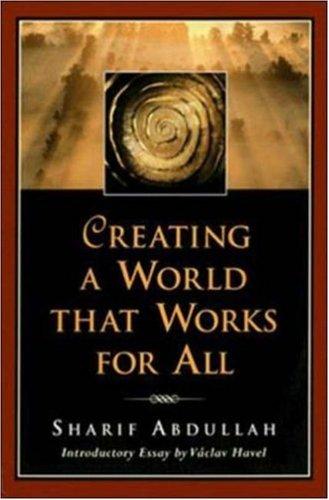
I'm still thinking about the message of  Occupy Wall Street; still yearning for a way forward that will lead to a more peaceful, equitable, and environmentally sustainable world that will benefit and meet the needs of all. I read several thought-provoking posts on this subject at Commonway Praxis, a blog written by Dr. Sharif Abdullah.  The following quote is from Dr. Abdullah's book, Creating A World That Works For All:
"We live in a world that works for only a few.  The problem  is exclusivity: the fundamental belief that we are separate  from one another.  All beings, all things, are One.  Our lives  are inextricably linked one to another.  Because of this, we cannot wage war against anything or  anyone without  waging war against ourselves.    Therefore, we are obliged to treat all beings the way we want to be treated.  There are no 'enemies' - all beings are expressions of the Sacred and must  be treated as such.  Some being cause pain to others; this does not meant that they are enemies.   Some beings are food for others; this is all the more reason to treat them as sacred.  Once we understand that we are interconnected, we have the responsibility to create a world that works for all."
"With this as our goal, the next question is obvious: how do we achieve it?  How do we avoid sinking into despair or cynicism?  And how do we avoid dabbling in utopian fantasies or engaging in 'pie-in-the-sky' religiosity?  In fact, we can change this world right now by shifting our consciousness and our values from a foundation of exclusivity to one of inclusivity. This shift in consciousness is the core of the world's major religions.  The essence of the moral code they urge upon us is inclusivity:

         What is hateful to you, do not do to others.  ~RABBI HILLEL

         Do not hurt others with that which hurts yourself.    ~ BUDDHA

         Do unto others whatever you would have them do unto you.  ~ JESUS
                   None of you is a believer until you love for your neighbor what you love for 
                    yourself.  ~ MUHAMMAD                                                                                                              
"Considering the clarity, simplicity, and consistency of these statements, one has to wonder what it is about the message of inclusivity that makes it nearly impossible for people to either comprehend or implement.  Why are there Jews, Buddhists Christians, Muslims, and many others around the world who are killing their fellow men and women when their traditions call for peace, nonviolence, and inclusivity?"
For me, the HOW is the missing piece that I've been searching for.  How do we implement the spiritual truths found in all the world's religions?  How do we put our spiritual teachings into concrete practice in our daily lives?  How do we embody the Divine and bring the Kingdom of Heaven down to this Earth that we all live on? 

Well, I'm very excited about a tool I recently learned about that's really answering the big HOW question for me.  Non Violent Communication, developed by Dr. Marshall Rosenberg, is much more than a communication method but a practical way to connect with "others" and live with Love toward all - beginning with our interpersonal relationships and expanding to peace at the global level. It is a way to practice the connections that make violence both inappropriate and impossible.  Below is the first in a series of Youtube videos filmed during a one-day introductory workshop in which Marshall Rosenberg teaches the basics of Non Violent Communication.  Altogether, more than three hours of this workshop can be viewed free of charge! 


Dr. Rosenberg's book is Non Violent Communication: A Language of Life.  Many additional resources can also be found online at the Center for Non Violent Communication and the NVC Academy.

By the way, PuddleDancer Press, the premier publisher of Nonviolent Communication related books, has recently donated hundreds of books on Non Violent Communication to various Occupy Wall Street libraries.                                                                              


Sunday, October 30, 2011

BUILDING A CARING ECONOMY: CARING PAYS!

Occupy Wall Street and the current economic condition of our country leave me wondering: Is there a way BEYOND left vs. right, Republican vs. Democrat, capitalist vs. socialist?  Is there a way FORWARD that will lead to a more peaceful, equitable, and environmentally sustainable world that will benefit and meet the needs of all?  

Well, I was delighted to discover Riane Eisler, who has devised a very sensible economic plan - a plan which demonstrates how caring for humans and the planet can actually be profitable.  Dr. Eisler (who is a social scientist, attorney, and internationally known author who is included in the award-winning book Great Peacemakers as one of 20 leaders for world peace, along with Mahatma Gandhi, Mother Teresa, and Martin Luther King) talks about her book The Real Wealth of the Nations and the need for an economics of caring in the following video:


Dr. Eisler's "Full Spectrum Job Creation Proposal: The Roadmap to a New Caring Economy,"  was submitted to President Obama in 2009 and can be read in it's entirety here.  Visit Dr. Eisler's websites here, here, and here for a wealth of additional material and to discover ways you can become involved.

Tuesday, October 18, 2011

WHAT IS THE BODY OF CHRIST?


Spiritual Insight from the David Ord's book Your Forgotten Self:

The body of Christ isn’t synonymous with Christianity.  It isn’t correlated with the churches. What it may be hard for many Christians to accept is that the body of Christ can be found among people of all faiths: Christians, Jews, Hindu, Buddhist, Muslim, Jain, Sikh, and so on.  The body of Christ is far more encompassing and includes the entirety of humanity.

“Christ” is a term, not a surname for Jesus of Nazareth. It’s the Greek equivalent of the Hebrew term messiah, meaning the anointed one. It used to be the term used for Israel’s kings, who were anointed with oil to signify their choice by God for the throne.

The messiah—the savior of the world—isn’t an individual, but is the whole of humanity empowered to at last be true to themselves as the image and likeness of God.

Jesus is definitive of what the Christ reality looks like, and in that sense he’s the “head” of the body. But a head is useless without the rest of the body. The body of Christ—that which will save humanity from its broken state—is comprised of all who begin to move out of the normal unconsciousness of human beings and into the enlightenment of consciousness. They become aware of the divine presence at the heart of their being, the heart of all being.

The term “Adam” doesn’t refer to a real person but is a symbol of humanity in our unconscious state. So too the Christ isn’t a single individual but is a symbol of humanity as we become conscious. This collective reality is made up of all who have become conscious of their oneness with God. When this awareness takes over our lives, we become a more evolved human, as was Jesus. He represents the next leap in our development as a species and is definitive of the new humanity emerging on the planet.

When we read that there's "no other name given by which we must be saved," it's not about saying a name, but about becoming what Jesus was: a conscious person. "In Jesus' name" isn't a statement to be tacked onto the end of prayers like a magical charm. His name represents the divine nature. When we awaken to the divine nature in ourselves, the image and likeness of God that we have always been but lost sight of, we become as Jesus was. It's in this sense there's "no other name." You have to become conscious in the way he was.

As awareness of our oneness with God increases, the impact isn’t just personal. It changes how we relate to each other. Recognition of our oneness with God leads to oneness among us. All barriers between the world’s peoples are broken down. The future of the human race involves the gathering together of all races and creeds to form one new human being. This collective “one new human being” is the Christ. You can read about this new humanity in Ephesians 2:15-22, where it’s likened to a house in which God dwells.

The divine dwells in us. As we recognize this in ourselves, we become the Christ that will save the world from its turmoil and usher in what Eckhart Tolle calls A New Earth—or in more ancient language, the kingdom of God.

This entire article can be accessed at The Body of Christ Means Conscious Individuals.