Pages

Showing posts with label Death to Self. Show all posts

Saturday, May 19, 2012

FORGIVENESS

“People are paralyzed by the tensions and contradictions in their own beliefs.  In turn, they shy away from examining their own behavior too closely…” (Sharif Abdullah, Creating a World That Works For All, p. 105).

We all need food, safety, security, belonging, love. Sometimes our need for these things is so desperate that we try to take them, maybe harming others in the process.  For me, the definition of “sin” is when we try to meet our very legitimate needs in a way that is harmful to ourselves or others. It bothers us to realize that we’ve done things in unskillful ways to get what we need; that we’ve not lived with integrity with our innermost values.  That is very difficult to face, so most people choose to run from self-examination.  We shove it down and hide it – sometimes so deep that it’s buried in the unconscious.  It takes great courage to go within and face ourselves, for when we do so, we find that our actions don’t match our values - that we’ve not lived in honesty with our own selves.  That’s why Joseph Campbell termed it “The Hero’s Journey” – to face our inner demons takes more courage than most of us have!

We seek forgetfulness in many ways – watching TV, shopping, busy-ness, etc.  We try to like ourselves in spite of the things we’ve done that bother us.  Some self-help teachings even advise looking in the mirror and saying, “I like you!” to build self-esteem.  It would be healthier to face those behaviors and find ways to live in alignment with our innate desire to live with compassion toward all. 

We have such a deep need to forgive ourselves that we’ve created a God “out there” who can forgive us and wipe our slate clean…what we really need is to face ourselves, understand ourselves, forgive ourselves, and move forward in alignment with our innermost values.  It’s an internal thing of facing it, understanding it, and finding forgiveness…

The truth is we have all tried to meet our perfectly legitimate needs with unskillful means, bringing harm to others and/or ourselves.  Some traditions call this facing the "shadow" or dark side.  Christian teaching puts it this way: we have all sinned and come short of the glory of God. This has been interpreted to mean that individuals are evil and deserve to die, when in fact we have all learned to live in ways that are not beneficial to ourselves or others.  How freeing it is to see that, face it, forgive ourselves because we were ignorant of any better way, and learn more skillful and less harmful means of getting our needs met.  In Scriptural language, this process has been described as confession, repentance (turning), forgiveness, and sanctification (the process of learning to live righteously). Whatever we call this process, may we find the deep courage to forgive ourselves for past mistakes and to live in alignment with the deepest desires of our hearts...

Wednesday, May 4, 2011

I COULD BE WRONG

Lately, I’ve been pondering the direction of the spiritual path.  My own journey is taking me from the fundamental toward the liberal.  And from what I read on the internet, many others seem to be on this same trajectory.  But I’ve encountered a few who seem to be traveling in the opposite direction.  In fact, “Religious fundamentalism has risen to worldwide prominence since the 1970s” (Annual Review), and "in March 2009, TIME magazine ranked the new Calvinist movement as one of the '10 Ideas Changing the World Right Now.'"  What to make of these, and other, movements of the Spirit in apparently opposite directions?

When I first began to see from a different perspective, I thought I had been misled.  I had believed lies, I thought, but was now seeing the truth.  Those fundamental beliefs I had previously held were wrong, but now I was on the right track.  Truthfully, the only thing that really happened was I moved into a new place of being judgmental!  Yes, I admitted I’d been wrong.  But, I reasoned, it wasn’t my fault – it was all those lies I’d been taught! NOW, though, I was following the Spirit, and I was RIGHT.  Truth with a capital “T” once again! Meanwhile, of course, some of a more liberal bent across the country and throughout the world had been discovering new-found truth in conservative ideas…

Gradually (and thankfully!), I moved into an understanding of the stages of spiritual growth and that we’re not necessarily right or wrong, but at different places along the path.  From that perspective, I’d like to present a possible explanation for these movements of the Spirit in seemingly opposite directions. 

Growth cannot take place without change, and change is a prerequisite for spiritual growth as well. So, whatever camp we’ve been in, whatever our beliefs have been, there has to be a willingness to change our previous positions before we can progress!  So (and this is a biggie!) we must admit that we’re wrong!  I think this is the toughest thing ever to ask our egos to do - admit we've been wrong, leave that ground of certainty, and strike out into unknown territory.

After error is finally seen and admitted, the next response is usually (like I did) to stake out a new “right” stand, and the process must begin all over again.  It’s very painful to admit error, and I believe that’s one among many of the reasons that the transition between stages can be a excruciating time on the spiritual journey – so much so that they’ve sometimes been termed “dark nights of the soul.”   These are “dark nights” because they’re a period of leaving behind what we’ve known and been sure of to enter into uncertainty (or unknowing, as the author of the Cloud of Unknowing put it).  Hopefully, we emerge from this process with a new humility, a fresh realization that we must hold our truths loosely, and a new-found ability to embrace mystery.

At this point it would seem to me that the greatest asset on the spiritual path is humility – the ability to realize I could be wrong.  Then again…I COULD BE WRONG!

Have you ever discovered that you had been wrong?  Did it lead to growth?

Thursday, April 21, 2011

RICHARD ROHR: SACRIFICE OF THE FALSE SELF


"The sacrificial instinct is the deep recognition that something always has to die for something bigger to be born.  We started with human sacrifice (Abraham and Isaac), we moved to animal sacrifice (the ritual killing of the Passover lamb described in Exodus 12), and we gradually get closer to what really has to be sacrificed—our own beloved ego—as protected and beloved as a little household lamb!  We will all find endless disguises and excuses to avoid letting go of what really needs to die.  And it is not other humans (firstborn sons of Egyptians), animals (lambs or goats), or even “meat on Friday” that God wants or needs.  It is always our false self that has to be let go, which is going to die anyway.

"By becoming the symbolic Passover Lamb, plus the foot-washing servant in John’s Gospel, Jesus makes the movement to the human and the personal very clear and quite concrete.  It is always “we,” in our youth, in our beauty, in our power and over-protectedness that must be handed over.  Otherwise, we will never grow up, big enough to “eat” of the Mystery of God and Love.  It really is about 'passing over' to the next level of faith and life.  And that never happens without some kind of 'dying to the previous levels'"  (Taken from "Wondrous Encounters for Lent" pp. 134-135 by Richard Rohr).

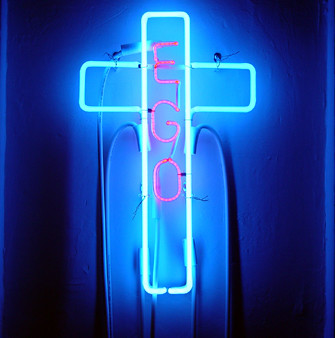
In my opinion, Richard Rohr has beautifully expressed in the above quotation the often-missed message that the cross of Jesus holds for us today.  As long as the ego is running things, we are always looking for someone to die in our place.  It's what happened to Jesus in those days, and it happens afresh inside of us when we trample underfoot and sacrifice the Christ consciousness by allowing the ego to rule our lives. 


Monday, March 14, 2011

BEYOND UNIVERSALISM...

There seems to be an unspoken agreement in much of Christendom that certain topics are 'sacred cows' - not to be questioned.  One such topic that is garnering a lively discussion lately (thanks to the upcoming release of Rob Bell's new book Love Wins) is hell.  I, for one, believe an atmosphere in which questions and open discussions are repressed creates a recipe for stagnation, and so I am thankful that the book is providing an opportunity for questions and the discussion of new ideas and perspectives. 

I had already been musing on the topic of what happens after death before the present fire-storm (pun intended) erupted.  Universalism, while a step in the right direction, still seems to me to be bound to the traditional concepts of heaven or hell in an after-life rather than as present realities. I wrote about my thoughts on death in a post titled Overcoming the Sting of Death.   And Logan Geen, over at A Sect Unto Myself submitted an excellent post titled Universalist? in which the reader is invited to explore beyond Universalism as commonly thought of.

In this "Death & Spirituality" interview from 1990, Bro. David Steindl-Rast provides a fresh and multi-faith perspective on what may happen after the death of the physical body.   Food for thought...fire for questions...and fodder for discussions...


What do you think?

Wednesday, February 2, 2011

THE MISSING CROSS

The Penal Substitution theory of atonement is taught in fundamentalist and evangelical circles as 'thus saith the Lord,' and so that was the only atonement theory I was exposed to for much of my Christian life.  Penal Substitution theory argues that Jesus was punished on the cross in the place of sinnersIt is generally recognized that the Penal Substitution theory was not taught in the early church and was conceived by a man named Anselm in 1098.  Both Luther and Calvin adhered to the Penal Substitution theory of atonement, however, and it became the dominate theory in Protestant churches.  But it wasn't until I began having some questions that I discovered this widely popular theory is only one among many atonement theories.  Two other major theories worth mentioning here are the Christus Victor theory and the Moral Example theory.  A summary of the different atonement theories can be read here


Despite the strong emphasis on the cross in the Penal Substitution theory, it seems to me that adherence to this theory has left us with a cross bereft of any life-changing power and resulted in a crossless Christianity.  Oh, there is much talk about Jesus' death on the cross - but little personal application.   Basically,  Christianity as we know it today has largely become an escapist religion:  Jesus died on the cross so I don't have to do the hard work of dying to my selfish nature (a.k.a. the ego, flesh, lower nature, carnal man, the anti-christ within us).  Jesus paid it all, so I don't have to....Jesus did it all, so I don't have to...Jesus lived a holy life, so I don't have to.  As a matter of fact, all I have to do is be sure to get him to cover up anything my selfish nature is guilty of - by gettin' it "under the blood."   And, finally, when God comes back and wrath is poured out on the entire planet - Well, none of it'll touch me, because I'll be raptured out of this world before the bad stuff starts... 

We have forgotten that Jesus called us to take up our cross daily and follow him.   Much benefit can be gained from the wisdom of Thomas Merton on this subject:  

        "...it is essential to remember that for a Christian "the word of the Cross" is nothing
         theoretical, but a stark and existential experience of union with Christ in His death in
         order to share in His resurrection. To fully "hear" and "receive" the word of the Cross
         means much more than simple assent to the dogmatic proposition that Christ died for
         our sins. It means to be "nailed to the Cross with Christ," so that the ego-self is no
         longer the principle of our deepest actions, which now proceed from Christ living in 

         us.  "I live, now not I, but Christ lives in me" (Gal, 2:19-20; see also Romans 8:5-17).  
         To receive the word of the Cross means the acceptance of a complete self-emptying, a
         Kenosis,  in union with the self-emptying Christ "obedient to death." (Phil. 2:5-11) It is
         essential to true Christianity that this experience of the Cross and of self-emptying be
         central in the life of the Christian so that he may fully receive the Holy Spirit and know
         (again by experience) all the riches of God in and through Christ" (John 14:16-17, 26;
         15:26-27; 16:7-15)"
Zen and the Birds of Appetite (p.55).

In the Moral Example theory, the call is to follow Jesus rather than have Jesus do it all so we don't have to. Jesus was the pattern son, who set an example that we are to follow - he showed us the way, and we are to travel that same way.  Christ suffered for us, leaving an example, that we should follow in his steps. As we do so, we become partakers in his death, burial, and resurrection.  That our 'old man' is crucified with him (Rom. 6:6) is not mere hyperbole, but must take place in like manner.  Although not physical, this death to our selfish nature is not only a very real experience, but a very painful one as well.  


Don Rogers posted an article at his Reflections blog by Steve Jones on this subject which I heartily agree with.  He said:
"Jesus’ death works a change in us so that we give up our sinful, self-absorbed life and walk in his steps. This is salvation, the life of cross-carrying discipleship….The message of the cross should always be coupled with the message of discipleship. We must take up our cross and follow Christ in a life of servanthood and love. It is common for the New Testament authors to speak of the cross, then to speak of our need to “die” to sin and self-centeredness. And that is the crucial point – the grand objective of the crucifixion. It is for our sanctification that Jesus gave his life. Paul’s declaration “I am crucified with Christ” should be ours.” You can read the entire post here.