Pages

Showing posts with label Love. Show all posts

Sunday, May 27, 2012

NATURE AND NONVIOLENCE

As I read the following article from one of my favorite authors and teachers, Thich Nhat Hanh, I thought it especially appropriate for Memorial Day. As we mourn those who have fallen in war, may we determine to be part of bringing into reality a world where violence does not take the lives of those we love and of fellow human beings.  Quotable: "A civilization in which we must kill and exploit others in order to live is not a healthy civilization. [...] To bring about peace within the human family, we must work for harmonious co-existence."   Namaste, ya'll....

Nature and Nonviolence

--by Thich Nhat Hanh (May 22, 2012)                                                          

                                                                                                                           Listen To Reading!


You don’t discriminate between the seed and the plant. You see that they ‘inter-are’ with each other, that they are the same thing. Looking deeply at the young cornstalk, you can see the seed of corn, still alive, but with a new appearance. The plant is the continuation of the seed.

The practice of meditation helps us to see things other people can’t see. We look deeply and we see that father and son, father and daughter, mother and son, mother and daughter, corn seed and cornstalk, have a very close relationship. That is why we should awaken to the fact, to the truth, that we inter-are. The suffering of one is the suffering of the other. [...] When we see that we and all living beings are made of the same nature, how can there be division between us? How can there be lack of harmony? When we realize our ‘interbeing nature’, we’ll stop blaming and exploiting and killing, because we know that we inter-are. That is the great awakening we must have in order for the Earth to be saved.

We human beings have always singled ourselves out from the rest of the natural world. We classify other animals and living beings as ‘Nature’, a thing apart from us, and act as if we’re somehow separate from it. Then we ask, “How should we deal with Nature?” We should deal with Nature the same way we should deal with ourselves: nonviolently. Human beings and Nature are inseparable. Just as we should not harm ourselves, we should not harm Nature.

Causing harm to other human beings causes harm to ourselves. Accumulating wealth and owning excessive portions of the world’s natural resources deprives fellow humans of the chance to live. Participating in oppressive and unjust social systems creates and deepens the gap between rich and poor, and aggravates the situation of social injustice. While the rest of the human family suffers and starves, the enjoyment of false security and wealth is a delusion.

It’s clear that the fate of each individual is inextricably linked to the fate of the whole human race. We must let others live if we ourselves want to live. The only alternative to coexistence is co-nonexistence. A civilization in which we must kill and exploit others in order to live is not a healthy civilization. [...] To bring about peace within the human family, we must work for harmonious co-existence. If we continue to shut ourselves off from the rest of the world, imprisoning ourselves in narrow concerns and immediate problems, we’re not likely to make peace or to survive. The human race is part of Nature. We need to have this insight before we can have harmony between people.

--Thich Nhat Hanh in "Nature and Nonviolence"

Saturday, May 19, 2012

FORGIVENESS

“People are paralyzed by the tensions and contradictions in their own beliefs.  In turn, they shy away from examining their own behavior too closely…” (Sharif Abdullah, Creating a World That Works For All, p. 105).

We all need food, safety, security, belonging, love. Sometimes our need for these things is so desperate that we try to take them, maybe harming others in the process.  For me, the definition of “sin” is when we try to meet our very legitimate needs in a way that is harmful to ourselves or others. It bothers us to realize that we’ve done things in unskillful ways to get what we need; that we’ve not lived with integrity with our innermost values.  That is very difficult to face, so most people choose to run from self-examination.  We shove it down and hide it – sometimes so deep that it’s buried in the unconscious.  It takes great courage to go within and face ourselves, for when we do so, we find that our actions don’t match our values - that we’ve not lived in honesty with our own selves.  That’s why Joseph Campbell termed it “The Hero’s Journey” – to face our inner demons takes more courage than most of us have!

We seek forgetfulness in many ways – watching TV, shopping, busy-ness, etc.  We try to like ourselves in spite of the things we’ve done that bother us.  Some self-help teachings even advise looking in the mirror and saying, “I like you!” to build self-esteem.  It would be healthier to face those behaviors and find ways to live in alignment with our innate desire to live with compassion toward all. 

We have such a deep need to forgive ourselves that we’ve created a God “out there” who can forgive us and wipe our slate clean…what we really need is to face ourselves, understand ourselves, forgive ourselves, and move forward in alignment with our innermost values.  It’s an internal thing of facing it, understanding it, and finding forgiveness…

The truth is we have all tried to meet our perfectly legitimate needs with unskillful means, bringing harm to others and/or ourselves.  Some traditions call this facing the "shadow" or dark side.  Christian teaching puts it this way: we have all sinned and come short of the glory of God. This has been interpreted to mean that individuals are evil and deserve to die, when in fact we have all learned to live in ways that are not beneficial to ourselves or others.  How freeing it is to see that, face it, forgive ourselves because we were ignorant of any better way, and learn more skillful and less harmful means of getting our needs met.  In Scriptural language, this process has been described as confession, repentance (turning), forgiveness, and sanctification (the process of learning to live righteously). Whatever we call this process, may we find the deep courage to forgive ourselves for past mistakes and to live in alignment with the deepest desires of our hearts...

Saturday, January 14, 2012

TOO MUCH CONVICTION?

Here in the Bible belt, it is common to talk with folks very passionate about their personal beliefs - and very passionately OPPOSED to those who hold different beliefs.  It is also common to hear emphatic statements to the effect that people who believe and teach differently deserve to "Burn in hell!" 

I am troubled and saddened by conversations such as these. Doubly so, I think, because as a former fundamentalist my own previous convictions would have aligned nicely with this brand of evangelism.  From my current understanding that the heart of Jesus' message is Love,  however, the driving force behind such passion appears to be hatred and fear.  

I read an article by Jay McDaniel over at Jesus, Jazz, and Buddhism that expresses some of my concerns more eloquently than I am able to, so I thought I'd post some excerpts:
What is that impulse within human beings to "strike down" others and its relation to the need to "be right?"...Why do we need to be "right" about things?  Many evangelically-minded Christians and Muslims do proselytize in aggressive ways.  Many believe that God commands them to seek converts across cultures; to proclaim that their religion is the only true religion; and to be clear that all who do not follow their religion are in big trouble, in this life or the next...more than a few wish they could pull bad ideas out of people's minds and replace them with what they believe is the Truth.  There is only one way to salvation, they say, and we happen to have discovered it.
Jesus taught that the best hope of humanity is not violence but love...Indeed the principle of non-harm was built into Jesus' teachings.  He was a pacifist, non-violent Jew.  He taught that, even as people tried to follow his way of love, they should pray for those who persecute them, turn the other cheek when someone slapped them, and sell their possessions and give to the poor.  He asked them to become the love they hoped to see in others.  Love was the Way which, for him, was also the Truth and the Life.  When he said "I am the Way and the Truth and the Life" this is what he had in mind.  He wanted others to become the Way and Truth and Life, too...

When other people are "wrong," we become angry.  Among Christians and Jews this anger is sometimes validated as righteous indignation.  We say "I am outraged.  I am mad as hell and I'm not going to take it anymore."  This indignation seems holy to us.  We feel right in being indignant.  We want to ventilate.  Some of us wrongly imagine that even God is filled with this kind of feeling.  We speak of a wrathful God and say that this wrath is called holiness.  We speak of God as scary and unloving: a holy warrior who is preoccupied with being right. For my part, I do not see holiness in righteous indignation.  I find holiness in tenderness, in forgiveness, in gentleness, in love.  

...[Sometimes belief is held] so tightly that the belief becomes a false god.  When we hold on this way, we divide the world into good and bad, right and wrong.  Many of us commit this sin all the time, liberals as well as conservatives.  We think they are "right" and others are "wrong."  We divide the world into believers and non-believers.  We become arrogant.  Sometimes arrogance can look very sophisticated.  But it is always smug and self-assured.  It is never humble and honest.  It wears protective armor covered with an emblem which says "I know and you don't."
...I appreciate the opening to the gospel of John, which sees Christ as the light that enlightens all people, not just Jesus; and which says that Jesus reveals the light, but does not exhaust it.  I have seen more than a little of this light in people of other religions and no religion.  I have also seen it in evangelical Christians.  I cannot join the critics in a wholesale critique of evangelical Christianity.  I think the spirit can flow even in those who might think they, and they alone, possess the spirit. 

I do understand the evangelical approach, because I find it in myself.  Implicitly if not explicitly, we are all evangelicals.  In espousing our own values there is an implicit universalism.  I would not be writing this article if I did not think it would be nice if you - my reader - might be affected by what I say.  I conclude with the hope that as we try to influence others with our views, we simultaneously avoid anger and greed; we cool off and calm down; we remember that the spirit can be at work in our lives even apart from our mediation; and we recognize that our way, at its best, is but one way of being open to the spirit of wisdom at work in the world.  Let's hold onto our own convictions with a relaxed grasp, lest we fall into the sin of too much conviction, and fall away from the very hope that rightly inspires our hearts: namely that the will of God be done on earth as it is in heaven. 
Read the entire article here.

Wednesday, December 14, 2011

FINDING CONNECTION THROUGH SOLITUDE

A couple of years ago, I read Thomas Merton's New Seeds of Contemplation.  Merton (seeing as how he was a monk) was big on solitude, and said that it's only by spending time in solitude that we can truly come to love others.  At that time, I couldn't understand how solitude could contribute to a greater love for our fellow beings...

But when it comes right down to it, isn't unity with the Divine and with fellow beings what we're all looking for?  Isn't that the essence of the spiritual path?  Michael Brown, author of the Presence Process, said "It was not enlightenment I was looking for at all; it was intimacy.  I was desperately seeking intimacy with myself, with God, with nature, with my family, with all humans I encountered, with my cats, with my writing, with plants, with the falling rain, with my pain, with my dreams and visions, and with all the minute aspects of this experience we call 'living our life,' like washing dishes and doing laundry.” It is not enlightenment we all crave, it's intimacy.  But to achieve intimacy, we've got to overcome what separates us.  That's why we have to "go inside" and get to know all the aspects of ourselves, become self-aware.  Humility develops as we face those inner demons common to all of us.   Only in becoming conscious of the forces that drive us we can conceive of the forces that may drive others.  In so doing, we come to see that we're all deeply the same, each of us capable of the greatest good and the greatest evil.  As we develop compassion for our own failings, compassion for others grows.  From this perspective, we become capable of genuine forgiveness; the barriers come down and we can end the separation! 

Solitude is a tough discipline that takes great courage.  Most of us would rather do anything than spend time alone in self-reflection in order to face ourselves!  It's one reason we tend to keep our minds so busy with activities; keeping our minds busy prevents us from seeing ourselves as we really are (warts and all). It is only in solitude and stillness that we can connect with what's really going on inside of us.  And connection to other beings is not possible unless that self-connection is first established.  Spending time A-Lone leads to the understanding that we are All-One...this heart-felt knowledge enables us to relate to one another with Love and Intimacy.   And, isn't that what we're all really longing for?

Tuesday, November 22, 2011

HOW TO CREATE A WORLD THAT WORKS FOR ALL

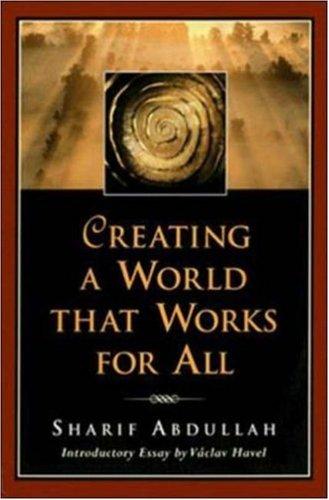
I'm still thinking about the message of  Occupy Wall Street; still yearning for a way forward that will lead to a more peaceful, equitable, and environmentally sustainable world that will benefit and meet the needs of all. I read several thought-provoking posts on this subject at Commonway Praxis, a blog written by Dr. Sharif Abdullah.  The following quote is from Dr. Abdullah's book, Creating A World That Works For All:
"We live in a world that works for only a few.  The problem  is exclusivity: the fundamental belief that we are separate  from one another.  All beings, all things, are One.  Our lives  are inextricably linked one to another.  Because of this, we cannot wage war against anything or  anyone without  waging war against ourselves.    Therefore, we are obliged to treat all beings the way we want to be treated.  There are no 'enemies' - all beings are expressions of the Sacred and must  be treated as such.  Some being cause pain to others; this does not meant that they are enemies.   Some beings are food for others; this is all the more reason to treat them as sacred.  Once we understand that we are interconnected, we have the responsibility to create a world that works for all."
"With this as our goal, the next question is obvious: how do we achieve it?  How do we avoid sinking into despair or cynicism?  And how do we avoid dabbling in utopian fantasies or engaging in 'pie-in-the-sky' religiosity?  In fact, we can change this world right now by shifting our consciousness and our values from a foundation of exclusivity to one of inclusivity. This shift in consciousness is the core of the world's major religions.  The essence of the moral code they urge upon us is inclusivity:

         What is hateful to you, do not do to others.  ~RABBI HILLEL

         Do not hurt others with that which hurts yourself.    ~ BUDDHA

         Do unto others whatever you would have them do unto you.  ~ JESUS
                   None of you is a believer until you love for your neighbor what you love for 
                    yourself.  ~ MUHAMMAD                                                                                                              
"Considering the clarity, simplicity, and consistency of these statements, one has to wonder what it is about the message of inclusivity that makes it nearly impossible for people to either comprehend or implement.  Why are there Jews, Buddhists Christians, Muslims, and many others around the world who are killing their fellow men and women when their traditions call for peace, nonviolence, and inclusivity?"
For me, the HOW is the missing piece that I've been searching for.  How do we implement the spiritual truths found in all the world's religions?  How do we put our spiritual teachings into concrete practice in our daily lives?  How do we embody the Divine and bring the Kingdom of Heaven down to this Earth that we all live on? 

Well, I'm very excited about a tool I recently learned about that's really answering the big HOW question for me.  Non Violent Communication, developed by Dr. Marshall Rosenberg, is much more than a communication method but a practical way to connect with "others" and live with Love toward all - beginning with our interpersonal relationships and expanding to peace at the global level. It is a way to practice the connections that make violence both inappropriate and impossible.  Below is the first in a series of Youtube videos filmed during a one-day introductory workshop in which Marshall Rosenberg teaches the basics of Non Violent Communication.  Altogether, more than three hours of this workshop can be viewed free of charge! 


Dr. Rosenberg's book is Non Violent Communication: A Language of Life.  Many additional resources can also be found online at the Center for Non Violent Communication and the NVC Academy.

By the way, PuddleDancer Press, the premier publisher of Nonviolent Communication related books, has recently donated hundreds of books on Non Violent Communication to various Occupy Wall Street libraries.                                                                              


Friday, September 2, 2011

A Letter From a 16 year old Oslo Survivor

Dear Anders Behring Breivik,

A lot of the friends I met at Utoya are dead and you are the perpetrator. You are the man who, by coincidence, didn’t kill me. I was lucky.

You might think that you have won. You might think that you have ruined something for the Labour Party and for people around the world who stand for a multicultural society by killing my friends and fellow party members.

Know that you have failed.

You haven’t only made the world stand together, you have set our souls on fire and should know we’ve never stood together as we do now. You talk about yourself as a hero, a knight. You are no hero. But you have created heroes. On Utoya that warm day in July, you created some of the greatest heroes the world has seen, you unified people from all over the world. Black and white, man and woman, red and blue, Christians and Muslims.

You made your victims martyrs, immortals, and you have shown the world that when one person can show as much hatred as you have done, imagine how much love we can show when we stand together? People who I thought hated me have given me hugs on the street, people I haven’t been in contact with for years have written 300 to 400 words about how much it means to them that I survived. What can you say about that? Have you broken anything? You have united us.

You have killed my friends, but you haven’t killed our cause, our opinions, our right to express ourselves. Muslim women got hugs of sympathy from random Norwegian women on the street and your goal was to protect Europe from Islam? Your actions worked against its purpose.

You deserve no thanks; your plan failed. A lot of people are angry, you are the most hated person in Norway. I am not angry. I do not fear you. You can’t touch us, we are greater than you. We do not answer evil with evil, as you wanted it. We fight evil with good. And we win.

Ivar Benjamin Østebø, aged 16.


Thanks to Humanity's Team for this blog post.

Tuesday, March 8, 2011

MY TAKE ON EVERYBODY’S TAKE ON ROB BELL’S TAKE ON HELL


OR…maybe not…maybe just my take on hell.  I was taught all my life to believe in a literal hell and a literal devil, and I firmly believed it.  I was angry when I read that people like Brian Mclaren had begun to question the doctrine of hell.  I thought that he was a heretic who would…bad as I hated to think it…go there.  I was outraged at the newer Bible translations that were “taking hell out of the Bible.”  I was as far from accepting a universalist position as could possibly be imagined.

But then, somehow I found myself questioning this doctrine of hell.  And, to even have these questions scared me to death!  When I found myself wondering about it, I’d try my best to ignore those nagging thoughts.  I’d shove ‘em to the back of my mind and try to not think about them.  I was successful for some time, but finally I came to a place where there was just no other option – it was imperative that I examine my thoughts and questions surrounding hell.  

Once my resistance was slightly lowered (very slightly, mind you), my first reaction was “Wouldn’t it be wonderful if it wasn’t true?  Wouldn’t it be wonderful if nobody went to hell?”  Of course, I was still far from believing that, but still…what a joyful thought it was!

I began to tentatively read about the history of hell and the origin of the devil.  I read articles from Tentmaker and articles on the meanings of the different words used for hell and for everlasting/eternal here  and here.  I skimmed (didn't read the whole book!) The Origin and History of the Doctrine of Endless Punishment by Thayer. I read the argument that Universalism was the prevailing doctrine of early Christianity here. I watched a documentary video from the History channel on the origins of hell and a video by MSNBC that told of Carlton Pearson's journey To Hell and Back when he renounced the doctrine of hell.  But I remained far from convinced.  Sometimes when I’d come across something particularly convincing, it would scare me and I'd run back to the safety of majority opinion.  A person can't see something if they're not willing to see it, and at that time I was still not ready to be convinced! 

I'm still far from figuring it all out, and I certainly don't claim to have all the answers.  But one thing I can say is that, after much deliberation, I've come to a very different view of hell than I previously adhered to. 

The first thing that changed dramatically was my understanding of judgment.  I think there's Biblical room to see judgment as something that happens while we are in this life.   Jesus taught that we will reap the consequences of our own actions, and Paul said that we will be rewarded in this very body for the deeds we have done - good or bad (2 Corin. 5:10)!  I also believe that God's chastening is redemptive in nature. I like what Brian McLaren said here about the wrath and judgment of God:  
"...wrath means God's displeasure that allows people to experience the consequences of their negative actions....So if we neglect the poor, there will be crime and revolutionary movements ... If we neglect our children, they'll feel alienated from us, hurting themselves and us. If we neglect the environment, we'll suffer erosion and global warming....And judgment in the conventional narrative means God sending people to hell. But what if this is based on a mistaken understanding? What if judgment means "setting things right," or "restoring justice?" So for God to come as judge to bring judgment would mean God coming to stop the oppressors from oppressing, the polluters from polluting, the violent from plundering, the greedy from hoarding, etc."
I also began to see at a new level that heaven and hell are indeed very real; very literal.  But also that they are both here on this earth - present realities, ways of living we can enter into here and now, as Rob Bell said in Velvet Elvis (p. 147).   Paul taught that the Kingdom of God IS peace and joy, and Jesus proclaimed the kingdom of Heaven is at hand - so close we can reach out and touch it!   I think hell on earth is created when we are consumed by the flames of our own anger and hate, tortured by desires which are never satisfied, and tormented by never-ending fears (1 John 4:18).   In this manner, hell is created, chosen, and lived in.  In this hell of our own making, the smoke of our torment does ascend up forever and ever (continually!) and no rest can be found day or night.  Moreover, we live in this condition in the very presence of the Lamb (Rev. 14: 9-11) oblivious to the rest and peace presently available to us in the Kingdom of Heaven!  

Why do we cling so perniciously to the notion of eternal conscious torment?  I think we live in that fear because deep down we believe God's goodness and love for all creation is simply too good to be true. We just find it too difficult to believe that God could be that good, that evil could actually be overcome with good, and that the worst of us could be won over with Love.   Others have written much more eloquently than I ever could in favor of God's triumph and ultimate reconciliation of all things, so I won't say more on that front.  The above mentioned resources are excellent, Richard Beck wrote beautifully on the subject here and here, and entire lists of articles and books can be found here and here.

But I do believe that Scripture teaches that hell will not prevail, that all enemies will be defeated, and that ultimately all things in heaven and in earth will be gathered together in the Christ.  I believe "all" means "ALL," and I hope Rob Bell comes out in Love Wins with a strong elucidation that lives up to the book's title. 


Wednesday, February 23, 2011

THE EVOLUTION OF CONSCIOUSNESS PART 1


The following is first in a three part series excerpted from "The Christ Is Not A Person The Evolution of Consciousness And The Destiny of Man" By J.C. Tefft:

Considering the evolution of Consciousness, as set forth in ancient scripture, the Biblical story reveals that the evolution of conscious awareness in Man is not about a chosen people who found their ‘Promised Land,’ but about the transformation of certain individuals in Hebrew society from lower to higher levels of conscious awareness in their lifetime, and in generations that followed. First one, then two, then four, then eight, and so on, as ever-greater numbers awakened in the Light. But someone was the first, and that someone, whoever he or she was, was the forerunner to a new race of Man. That someone had awakened to a higher calling, and following that awakening, most likely described it to others, as best he or she could, in conceptual, metaphorical terms in an attempt to communicate at least something of the experience, even though it was not the experience itself.

One problem that the earliest of enlightened beings continuously faced is that others in their societies were either thoroughly unenlightened, or at most, less enlightened than they. This meant that the others did not truly understand what the enlightened ones meant when they spoke of the ending of sorrow, or of denying self, or of realizing Nirvana, or of entering the Kingdom of Heaven, even though some may have sensed something of the Truth of it, albeit in more limited ways.

If we trace the history of conscious awakening in ancient, Biblical lore, we learn first of an individual named Adam (which interpreted means ‘Man’) who metaphorically represents early Man in whom the capacity to think emerged. This is indicated by his ability to ‘name,’ which is to say, to perceive and conceptualize outer things. Much later, another Man, metaphorically referred to as Noah, is said to have lived ‘five hundred years … and was perfect in his generations,’ for he ‘found grace in God’s eyes.’ This is to say, he awakened to a level of Awareness in himself that was above and beyond Adamic Man. After Noah there arose yet another Man, metaphorically referred to as Abraham, the ‘exalted father of many,’ of whom God said He would make ‘nations out of thee’ because Abraham was more consciously Aware than those who had come before.

Thursday, February 17, 2011

GOD IS ONE

The following is adapted from Twelve Lessons in Spirituality by Kevin J. Todeschi:

One of the great ironies of human nature is the fact that the very structure intended to enrich our relationship with God is the one thing which divides us most as a human family. For countless eons, more wars have been fought on religious principles than for any other reason. Even to this day, wars, bloodshed, political battles, and countless examples of our inhumanity to one another are commonplace as one group tries to instill (or enforce) its belief systems, its politics, or the supremacy of its God onto the lives of others.

These conflicts are not simply between various religions but are also within each denomination. There are sects within Christianity, Buddhism, Judaism, Hinduism, Islam-within every religion!-many convinced that they are just a little more right than anyone else. Even various churches, temples, and synagogues have found differences with other members of their own sect who have somehow fallen away from the "original" or the "true" faith.

In addition to separating people from one another, these conflicts have also caused individuals to become disillusioned with religion-some even becoming convinced that religion is a waste of time. Too often, the result has been that people have given up their faith in God because of their disappointment in humankind.


Interestingly enough, the Edgar Cayce material states that part of the problem is due to our ignorance of our oneness with one another.

Cayce's information presents a hopeful and inspiring approach to spirituality and religion that inextricably weaves all of humanity together. Rather than focusing upon the form of specific religions or dogmas, the readings instead focus upon the importance of every single soul attempting to manifest an awareness of the living Spirit in the earth.

From Cayce's perspective, our goal is not to simply wait for heaven or to escape the earth; instead, we are challenged to bring an awareness of the Creator into our lives and into our surroundings wherever we may be, right now.

There is a common bond we all share as a collective humanity: There is but one God, and we are all God's children. In order to reawaken that sense of connectedness we share with one another, the readings state that the start of any spiritual journey should begin with the knowledge that the Lord God is One. Regardless of the name we call God or the religion on earth that we feel drawn to, there is but one Creator, one Source, one Law. In fact, perhaps more than anything else, this concept of "oneness" is the underlying philosophy of the Edgar Cayce readings.

This notion of oneness in a world so filled with variety may, at first, seem a difficult concept to comprehend. After all, we are surrounded by a myriad of plants, trees, animals, experiences, and people. Rather than attempting to make all things the same, however, oneness suggests instead that we have the opportunity to view this rich diversity as an example of the multiple ways in which the One Spirit tries to find expression in our lives. Since there is only one God-the source of all that exists-ultimately, the universe must be composed of only one Force.

Oneness as a force implies that all things are interrelated. Every one of us has a connection to one another, the earth, the universe, and to God. This one force is a force for good which is attempting to bring the spirituality of the Creator into the earth. Unfortunately, because of our limited awareness of the power of free will, individuals are able to direct that force into selfish purposes and desires, creating "evil" in the process.

In terms of spirituality, the concept of oneness suggests that God is not limited to expressing through one religion alone. Instead, the Creator manifests in individuals' lives because of their faith and because of their relationship to the spiritual Source, not because of their specific religion. From Cayce's perspective, religion is the form in which individuals attempt to understand the manifestation of this Spirit. God can (and does!) work through every soul in the earth.

The good news is that, in spite of how things may appear in the world today, the readings assert that all of Creation will eventually be brought into an awareness of this oneness and of the Law of Love which it implies. One of our challenges as individuals is to make the world a better place because we have lived in it. Perhaps the best approach to this consciousness is reflected in the Bible when it states that we must love God with all our heart, mind, and soul, and our neighbor as ourselves.

The entire article can be read here.


Tuesday, February 8, 2011

OVERCOMING THE STING OF DEATH

The Buddhist principle of impermanence teaches that individuals are like flowers that bloom for a brief time and then fade away.  If I understand this principle correctly, all things are said to be in a constant state of change but also of interconnection and unity – a process of flux and flow from one form to another.  For example, moisture in the form of clouds becomes dew, mist, fog, rain, snow, or ice and falls to the earth. There, it becomes ground water and flows along in streams and rivers, sustaining and cleansing all of life. The water becomes a part of all that is nourished by it – every plant, animal, or human.  Finally, the moisture evaporates – becoming cleansed and renewed in the process – and is transformed into clouds to begin the process again. And so it is with all of life.  While the duration of living things seems brief to us, nothing is ever really lost – all things are merely transformed. 

This is in accordance with The First Law of Thermodynamics, which says that energy cannot be created or destroyed, simply transformed from one type to another. Digging deep into Christian teachings, agreement can be found there as well: men wither like the grass of the field and fade in the manner of a flower.  Life is portrayed as a vapor that appears for a little while and then vanishes from our field of perception (James 4:14).   But we also likewise find the good news that all things are restored, for “the thing that hath been, it is that which shall be…and there is no new thing under the sun” (Ecc. 1:9).  And again, “That which hath been is now; and that which is to be hath already been…” (Ecc. 3:15).  Man goes back to dust, and the spirit goes back to God who gave it (Ecc. 12:7). Nothing is ever lost, and what was, will be again.

We, too, like all things, are being transformed, and it does not yet appear what we shall be (1 John 3:2).  We cannot see deeply enough into the nature of reality to discover the transformation that takes place as our present forms fade away.  But we can know that when Christ appears to us – when we come into a level of awareness that enables us to perceive the Christ within us, then we shall be like him.  AND, when that happens, we’ll also be able to see God as he really is: as Love.  With the understanding that God is truly Love, there is no longer any reason to be afraid of death.  Death can be seen for what it is: not a punishment, but as part of the natural process of the renewal of all things.   With this understanding, Rev. 21:4-5 becomes a current reality rather than a dim promise for the distant future: “And God shall wipe away all tears from their eyes; and there shall be no more death, neither sorrow, nor crying, neither shall there be any more pain: for the former things are passed away.  Behold, I make ALL THINGS NEW…!”  Once the veil that keeps people from seeing the nature of reality is removed, death will be swallowed up in victory, and the Lord will wipe all tears off ALL faces (Isa 25:7-8).  It is only our limited perception that makes us cry…

All must indeed face death, for death is part of the natural process of renewal and happens to all.  But death does lose its sting and brings us sorrow no longer.  Instead, we can rejoice, for the reality is NOTHING IS EVER TRULY LOST - merely changed from one form to another.  That's really good news!

Saturday, January 29, 2011

FEAR...OR LOVE?

“Sin” – all the evil done by humankind – is at its core a result of humans trying to provide for their own safety, security, well-being and happiness at the expense of others.  Sin, or evil, springs from the root of fear – fear of not having enough.  Enough money, food, shelter, clothing or resources to survive.  Or enough power over others to be able to procure from them what seems necessary for personal survival.  All this to preserve the separate physical body that we have identified with. 

I love this quote from Eknath Easwaran over at Blue Mountain Center of Meditation:
To be truly secure, we must begin to find a source of security within ourselves. Even the bravest among us have many fears. Behind the attachment to money or possessions, for example, you will always find the fear of loss. Attachment to prestige brings the nagging fear of what others think of us. The thirst for power feeds the fear that others may be stronger. Every self-centered desire brings the fear that we may not get what we desire.
One could make a Sears catalog of these fears, but all stem from one fatal superstition: thinking of ourselves as merely physical creatures, separate from the rest of life. As our sense of oneness with the rest of life deepens, we step out of the world of fear to live in the world of love.
What would our world look like if we realized the truth of the interconnectedness and oneness Scripture pictures as “a many membered body” (1 Corin. 12:4-27), who are “members one of another” (Eph. 4:25)?   “That there should be no division in the body, but that the members should have the same care for one another” (1 Corin. 12:25).  What would it look like if we actually lived the more excellent way of LOVE that Scripture goes on to describe in I Corin. 13?

Fear blinds to the truth that we are all connected and that what is done to one affects the whole.  Fear prevents us from seeing that when I harm my neighbor, I am harming myself, for if “…one member suffer, all the members suffer with it…” (1 Corin. 12:26).  Fear is what prevents us from living in love. What if we could set our fears aside and see the truth of the appeal to love our neighbors AS we love ourselves?  What a wonderful world that would be…the Kingdom of Heaven on earth.

Monday, January 10, 2011

CHRIST IS THE WAY

The following is a transcript from an interview in “ONE – The Movie in which Wayne Teasdale beautifully addresses the spirit in which Jesus is the way, the truth, and the life.

"It is not those who say Lord, Lord who will enter the Kingdom of heaven, but those who do the will of the Father.  And what is that will?  He illustrates it in Matthew 25:40 when he talks about the final judgment and how to be saved.  He says that then the King will say, meaning God, Come ye blessed of my Father, and inherit the Kingdom that was prepared for you from the beginning.  Because when I was hungry, you gave me something to eat, when I was thirsty, you gave me something to drink.  When I was naked you clothed me, when I was a stranger, you welcomed me, when I was imprisoned you visited me, when I was sick you consoled me.  

"When, Lord, when did we do this?  When you did it to the least of my brethren.  It doesn’t say anything about faith in himself, faith in Jesus.  Now, the Scripture scholars tell us we only know six sentences Jesus actually spoke – maybe even less than that.  And to say…they will always bring up this I am the way, the truth, and the life.  Okay, let’s take a peek at that, and illustrate that in spirit rather than in the letter. If God is love itself, infinite love, and Jesus is the incarnation of that love, he is come to reveal the essence of that love through his actions more than his words.  That by being loving in that way – that selfless way – that is leading to the mystery of the Father, who is infinite love itself.  To the extent that he is teaching that, illustrating that, he is the truth of that reality.  And to the extent that he embodies that – that is the way of life.  If a Buddhist, a Hindu, a Jew, an animist, an atheist, achieves that level of love in their life, not only do they know God, they know Christ…because Christ and God are that love.

"So you see this kind of narrow kind of interpretation leads to a kind of ossification of understanding.  And I like to say narrow is the way that leads to eternal life, but it’s not narrow-mindedness.  It’s love in action – you, know, it’s much deeper than that.  And they don’t talk about love too much…they talk about, you know, do you know Jesus Christ.  Well, do you REALLY know Jesus Christ?  In that deeper, Biblical sense of intimacy with the Divine – do you embody that?  Do you incarnate that?  Do you radiate that?  I think that’s closer to what Christ was talking about – to what the gospel was talking about."

The entire movie is available to watch online for free here

Sunday, November 28, 2010

We Are One

A couple of years ago, I had a revelation – I saw that the reason Jesus said to “do unto others as you would have them do unto you” is because WE ARE ONE - we are all part of one another.  We are a many-membered body, and a man does not want to hurt his own body!  Right there alongside the Golden Rule is “what ye measure out, it shall be measured again unto you.”  So if I try to hurt others, oppress others, gain from others, then I hurt myself, oppress myself, cause myself loss.

With my Baptist background, this was a totally new and very radical thought to me. But by this time I had grown used to the fact that God is a pretty radical God, so I began looking in Scripture for confirmation.  And of course it is there in bountiful measure even though I had not been able to see it until my eyes were opened to it.  First of all, “the Lord our God is ONE Lord” (Duet 6:4).  One means “that which is united as one in contrast to separate parts” (Dictionary of Biblical Languages).  And unity means “the quality or state of not being multiple” (Mer. Web. Online Dictionary). 

The body of Christ is a many-membered body (1Corin. 12:4-27, Eph. 4:25).  “We, being many, are one body in Christ, and every one members one of another” (Rom. 12:5) There should be no schism in the body, but the members should have the same care for one another (1 Corin. 12:25).  And whether one member suffer, all the members suffer with it, or one member be honored, all the members rejoice with it (vs. 26). Yes, there are diversities (1 Corin. 12: 4-5) but it is all the same Spirit that is given to every man (vs. 7).  So, who is my fellow member of the body of Christ?  When we ask that, it’s like asking, “Who is my neighbor?” and Jesus’ answer to that was a Samaritan, a person considered to be totally excluded from the Kingdom of God.  WOW! - my neighbor (whoever he/she is!) is part of the same body of Christ that I am!  We are to love our neighbor as ourselves because our neighbor IS a part of ourselves!  And when I harm my neighbor, it is harming myself, for my neighbor is part of me.  My neighbor may not understand this yet, and may harm me – not realizing that when he does so he injures himself. We are all united – all ONE.  


This means that we are to love one another as we would love our self. No one hates his own flesh!  And we suffer as long as we keep harming others, because what we are doing in actuality is harming our own selves.  When we have hatred, bitterness, and resentment toward others, we will reap that in our own lives and be filled with sorrows until we learn that what we intend for others will come back to us.  Until we learn this, we will suffer.  And this is the lesson that suffering is intended to teach.

 One more insight, for now:  

“…seeing that ye have put off the old man with his deeds; And have put on the new man, which is renewed in knowledge after the image of him that created him: Where there is neither Greek nor Jew, circumcision nor uncircumcision, Barbarian, Scythian, bond nor free: but Christ is all, and in all” (Col 3:9-11). 

Previously, I looked at these verses as meaning that when “they” all come into Christ, there will be no more divisions.  Now I have seen that it is when “I” shed the old man (a.k.a. carnal mind, ego) and come into renewed knowledge, this is a place where “I” see there ARE no divisions – only unity in diversity.  Where I can look with renewed perspective and see there is no Barbarian, Scythian, Buddhist, Hindu, etc. but that Christ IS all and is IN ALL.   

The ramifications of these insights are enormous and have led me many new places, which I hope to write more about if I can even find words to express the wonder of it.  Although mine has been a journey into a greater knowledge of the Love of God, many will view it as a journey from orthodoxy into heresy.  So be it.  The journey is scary, but onward I must go.  The Lord has torn down my reliance on many commonly-held views and continued to abolish so many traditional assumptions of truth in my life until I felt I stood all alone.  Now, my circle of inclusiveness has been expanded into yet another new place.  A large place that includes all and where I can love all because they are just on a different place on this journey; a place where I can let others be free to be where they are, yet not allow them to tie me in any one place, for I am free to follow.  I must follow, or I will die – for to follow is Life itself. 

 O! Give us grace, Lord, to love one another…  

That they may be one, as thou, Father, art in me, and I in thee, that they may be one in us...I in them, and thou in me, that they may be made perfect in one”
(John 17:21,23)