Pages

Showing posts with label Inclusiveness. Show all posts

Sunday, May 27, 2012

NATURE AND NONVIOLENCE

As I read the following article from one of my favorite authors and teachers, Thich Nhat Hanh, I thought it especially appropriate for Memorial Day. As we mourn those who have fallen in war, may we determine to be part of bringing into reality a world where violence does not take the lives of those we love and of fellow human beings.  Quotable: "A civilization in which we must kill and exploit others in order to live is not a healthy civilization. [...] To bring about peace within the human family, we must work for harmonious co-existence."   Namaste, ya'll....

Nature and Nonviolence

--by Thich Nhat Hanh (May 22, 2012)                                                          

                                                                                                                           Listen To Reading!


You don’t discriminate between the seed and the plant. You see that they ‘inter-are’ with each other, that they are the same thing. Looking deeply at the young cornstalk, you can see the seed of corn, still alive, but with a new appearance. The plant is the continuation of the seed.

The practice of meditation helps us to see things other people can’t see. We look deeply and we see that father and son, father and daughter, mother and son, mother and daughter, corn seed and cornstalk, have a very close relationship. That is why we should awaken to the fact, to the truth, that we inter-are. The suffering of one is the suffering of the other. [...] When we see that we and all living beings are made of the same nature, how can there be division between us? How can there be lack of harmony? When we realize our ‘interbeing nature’, we’ll stop blaming and exploiting and killing, because we know that we inter-are. That is the great awakening we must have in order for the Earth to be saved.

We human beings have always singled ourselves out from the rest of the natural world. We classify other animals and living beings as ‘Nature’, a thing apart from us, and act as if we’re somehow separate from it. Then we ask, “How should we deal with Nature?” We should deal with Nature the same way we should deal with ourselves: nonviolently. Human beings and Nature are inseparable. Just as we should not harm ourselves, we should not harm Nature.

Causing harm to other human beings causes harm to ourselves. Accumulating wealth and owning excessive portions of the world’s natural resources deprives fellow humans of the chance to live. Participating in oppressive and unjust social systems creates and deepens the gap between rich and poor, and aggravates the situation of social injustice. While the rest of the human family suffers and starves, the enjoyment of false security and wealth is a delusion.

It’s clear that the fate of each individual is inextricably linked to the fate of the whole human race. We must let others live if we ourselves want to live. The only alternative to coexistence is co-nonexistence. A civilization in which we must kill and exploit others in order to live is not a healthy civilization. [...] To bring about peace within the human family, we must work for harmonious co-existence. If we continue to shut ourselves off from the rest of the world, imprisoning ourselves in narrow concerns and immediate problems, we’re not likely to make peace or to survive. The human race is part of Nature. We need to have this insight before we can have harmony between people.

--Thich Nhat Hanh in "Nature and Nonviolence"

Saturday, January 14, 2012

TOO MUCH CONVICTION?

Here in the Bible belt, it is common to talk with folks very passionate about their personal beliefs - and very passionately OPPOSED to those who hold different beliefs.  It is also common to hear emphatic statements to the effect that people who believe and teach differently deserve to "Burn in hell!" 

I am troubled and saddened by conversations such as these. Doubly so, I think, because as a former fundamentalist my own previous convictions would have aligned nicely with this brand of evangelism.  From my current understanding that the heart of Jesus' message is Love,  however, the driving force behind such passion appears to be hatred and fear.  

I read an article by Jay McDaniel over at Jesus, Jazz, and Buddhism that expresses some of my concerns more eloquently than I am able to, so I thought I'd post some excerpts:
What is that impulse within human beings to "strike down" others and its relation to the need to "be right?"...Why do we need to be "right" about things?  Many evangelically-minded Christians and Muslims do proselytize in aggressive ways.  Many believe that God commands them to seek converts across cultures; to proclaim that their religion is the only true religion; and to be clear that all who do not follow their religion are in big trouble, in this life or the next...more than a few wish they could pull bad ideas out of people's minds and replace them with what they believe is the Truth.  There is only one way to salvation, they say, and we happen to have discovered it.
Jesus taught that the best hope of humanity is not violence but love...Indeed the principle of non-harm was built into Jesus' teachings.  He was a pacifist, non-violent Jew.  He taught that, even as people tried to follow his way of love, they should pray for those who persecute them, turn the other cheek when someone slapped them, and sell their possessions and give to the poor.  He asked them to become the love they hoped to see in others.  Love was the Way which, for him, was also the Truth and the Life.  When he said "I am the Way and the Truth and the Life" this is what he had in mind.  He wanted others to become the Way and Truth and Life, too...

When other people are "wrong," we become angry.  Among Christians and Jews this anger is sometimes validated as righteous indignation.  We say "I am outraged.  I am mad as hell and I'm not going to take it anymore."  This indignation seems holy to us.  We feel right in being indignant.  We want to ventilate.  Some of us wrongly imagine that even God is filled with this kind of feeling.  We speak of a wrathful God and say that this wrath is called holiness.  We speak of God as scary and unloving: a holy warrior who is preoccupied with being right. For my part, I do not see holiness in righteous indignation.  I find holiness in tenderness, in forgiveness, in gentleness, in love.  

...[Sometimes belief is held] so tightly that the belief becomes a false god.  When we hold on this way, we divide the world into good and bad, right and wrong.  Many of us commit this sin all the time, liberals as well as conservatives.  We think they are "right" and others are "wrong."  We divide the world into believers and non-believers.  We become arrogant.  Sometimes arrogance can look very sophisticated.  But it is always smug and self-assured.  It is never humble and honest.  It wears protective armor covered with an emblem which says "I know and you don't."
...I appreciate the opening to the gospel of John, which sees Christ as the light that enlightens all people, not just Jesus; and which says that Jesus reveals the light, but does not exhaust it.  I have seen more than a little of this light in people of other religions and no religion.  I have also seen it in evangelical Christians.  I cannot join the critics in a wholesale critique of evangelical Christianity.  I think the spirit can flow even in those who might think they, and they alone, possess the spirit. 

I do understand the evangelical approach, because I find it in myself.  Implicitly if not explicitly, we are all evangelicals.  In espousing our own values there is an implicit universalism.  I would not be writing this article if I did not think it would be nice if you - my reader - might be affected by what I say.  I conclude with the hope that as we try to influence others with our views, we simultaneously avoid anger and greed; we cool off and calm down; we remember that the spirit can be at work in our lives even apart from our mediation; and we recognize that our way, at its best, is but one way of being open to the spirit of wisdom at work in the world.  Let's hold onto our own convictions with a relaxed grasp, lest we fall into the sin of too much conviction, and fall away from the very hope that rightly inspires our hearts: namely that the will of God be done on earth as it is in heaven. 
Read the entire article here.

Saturday, December 31, 2011

THE CHRISTIAN MEANING OF ENLIGHTMENT

This video was recorded at Science and Nonduality Conference in 2011. Father Richard Rohr is a Franciscan Priest and an Author. In this excellent talk he presents the similarities, the differences, and the complementarities between the Eastern and Western understandings of transformation. Some have called the goal enlightenment, some salvation, some ecstasy, nirvana, or heaven. What is the goal of the spiritual journey according to the main line Christian tradition? What Christian spirituality has called the unitive way has often described as non-dual consciousness by Hinduism, Buddhism and Taoism. Are we often seeking the same thing? How can we honor and respect each of these spiritual traditions?                        


Wednesday, December 14, 2011

FINDING CONNECTION THROUGH SOLITUDE

A couple of years ago, I read Thomas Merton's New Seeds of Contemplation.  Merton (seeing as how he was a monk) was big on solitude, and said that it's only by spending time in solitude that we can truly come to love others.  At that time, I couldn't understand how solitude could contribute to a greater love for our fellow beings...

But when it comes right down to it, isn't unity with the Divine and with fellow beings what we're all looking for?  Isn't that the essence of the spiritual path?  Michael Brown, author of the Presence Process, said "It was not enlightenment I was looking for at all; it was intimacy.  I was desperately seeking intimacy with myself, with God, with nature, with my family, with all humans I encountered, with my cats, with my writing, with plants, with the falling rain, with my pain, with my dreams and visions, and with all the minute aspects of this experience we call 'living our life,' like washing dishes and doing laundry.” It is not enlightenment we all crave, it's intimacy.  But to achieve intimacy, we've got to overcome what separates us.  That's why we have to "go inside" and get to know all the aspects of ourselves, become self-aware.  Humility develops as we face those inner demons common to all of us.   Only in becoming conscious of the forces that drive us we can conceive of the forces that may drive others.  In so doing, we come to see that we're all deeply the same, each of us capable of the greatest good and the greatest evil.  As we develop compassion for our own failings, compassion for others grows.  From this perspective, we become capable of genuine forgiveness; the barriers come down and we can end the separation! 

Solitude is a tough discipline that takes great courage.  Most of us would rather do anything than spend time alone in self-reflection in order to face ourselves!  It's one reason we tend to keep our minds so busy with activities; keeping our minds busy prevents us from seeing ourselves as we really are (warts and all). It is only in solitude and stillness that we can connect with what's really going on inside of us.  And connection to other beings is not possible unless that self-connection is first established.  Spending time A-Lone leads to the understanding that we are All-One...this heart-felt knowledge enables us to relate to one another with Love and Intimacy.   And, isn't that what we're all really longing for?

Tuesday, November 22, 2011

HOW TO CREATE A WORLD THAT WORKS FOR ALL

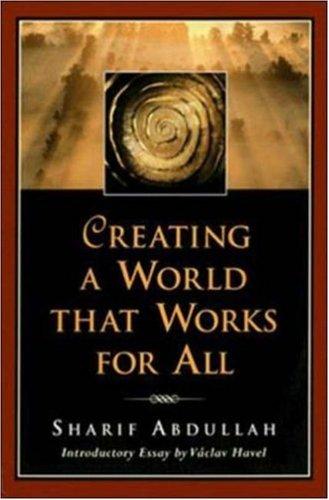
I'm still thinking about the message of  Occupy Wall Street; still yearning for a way forward that will lead to a more peaceful, equitable, and environmentally sustainable world that will benefit and meet the needs of all. I read several thought-provoking posts on this subject at Commonway Praxis, a blog written by Dr. Sharif Abdullah.  The following quote is from Dr. Abdullah's book, Creating A World That Works For All:
"We live in a world that works for only a few.  The problem  is exclusivity: the fundamental belief that we are separate  from one another.  All beings, all things, are One.  Our lives  are inextricably linked one to another.  Because of this, we cannot wage war against anything or  anyone without  waging war against ourselves.    Therefore, we are obliged to treat all beings the way we want to be treated.  There are no 'enemies' - all beings are expressions of the Sacred and must  be treated as such.  Some being cause pain to others; this does not meant that they are enemies.   Some beings are food for others; this is all the more reason to treat them as sacred.  Once we understand that we are interconnected, we have the responsibility to create a world that works for all."
"With this as our goal, the next question is obvious: how do we achieve it?  How do we avoid sinking into despair or cynicism?  And how do we avoid dabbling in utopian fantasies or engaging in 'pie-in-the-sky' religiosity?  In fact, we can change this world right now by shifting our consciousness and our values from a foundation of exclusivity to one of inclusivity. This shift in consciousness is the core of the world's major religions.  The essence of the moral code they urge upon us is inclusivity:

         What is hateful to you, do not do to others.  ~RABBI HILLEL

         Do not hurt others with that which hurts yourself.    ~ BUDDHA

         Do unto others whatever you would have them do unto you.  ~ JESUS
                   None of you is a believer until you love for your neighbor what you love for 
                    yourself.  ~ MUHAMMAD                                                                                                              
"Considering the clarity, simplicity, and consistency of these statements, one has to wonder what it is about the message of inclusivity that makes it nearly impossible for people to either comprehend or implement.  Why are there Jews, Buddhists Christians, Muslims, and many others around the world who are killing their fellow men and women when their traditions call for peace, nonviolence, and inclusivity?"
For me, the HOW is the missing piece that I've been searching for.  How do we implement the spiritual truths found in all the world's religions?  How do we put our spiritual teachings into concrete practice in our daily lives?  How do we embody the Divine and bring the Kingdom of Heaven down to this Earth that we all live on? 

Well, I'm very excited about a tool I recently learned about that's really answering the big HOW question for me.  Non Violent Communication, developed by Dr. Marshall Rosenberg, is much more than a communication method but a practical way to connect with "others" and live with Love toward all - beginning with our interpersonal relationships and expanding to peace at the global level. It is a way to practice the connections that make violence both inappropriate and impossible.  Below is the first in a series of Youtube videos filmed during a one-day introductory workshop in which Marshall Rosenberg teaches the basics of Non Violent Communication.  Altogether, more than three hours of this workshop can be viewed free of charge! 


Dr. Rosenberg's book is Non Violent Communication: A Language of Life.  Many additional resources can also be found online at the Center for Non Violent Communication and the NVC Academy.

By the way, PuddleDancer Press, the premier publisher of Nonviolent Communication related books, has recently donated hundreds of books on Non Violent Communication to various Occupy Wall Street libraries.                                                                              


Tuesday, October 18, 2011

WHAT IS THE BODY OF CHRIST?


Spiritual Insight from the David Ord's book Your Forgotten Self:

The body of Christ isn’t synonymous with Christianity.  It isn’t correlated with the churches. What it may be hard for many Christians to accept is that the body of Christ can be found among people of all faiths: Christians, Jews, Hindu, Buddhist, Muslim, Jain, Sikh, and so on.  The body of Christ is far more encompassing and includes the entirety of humanity.

“Christ” is a term, not a surname for Jesus of Nazareth. It’s the Greek equivalent of the Hebrew term messiah, meaning the anointed one. It used to be the term used for Israel’s kings, who were anointed with oil to signify their choice by God for the throne.

The messiah—the savior of the world—isn’t an individual, but is the whole of humanity empowered to at last be true to themselves as the image and likeness of God.

Jesus is definitive of what the Christ reality looks like, and in that sense he’s the “head” of the body. But a head is useless without the rest of the body. The body of Christ—that which will save humanity from its broken state—is comprised of all who begin to move out of the normal unconsciousness of human beings and into the enlightenment of consciousness. They become aware of the divine presence at the heart of their being, the heart of all being.

The term “Adam” doesn’t refer to a real person but is a symbol of humanity in our unconscious state. So too the Christ isn’t a single individual but is a symbol of humanity as we become conscious. This collective reality is made up of all who have become conscious of their oneness with God. When this awareness takes over our lives, we become a more evolved human, as was Jesus. He represents the next leap in our development as a species and is definitive of the new humanity emerging on the planet.

When we read that there's "no other name given by which we must be saved," it's not about saying a name, but about becoming what Jesus was: a conscious person. "In Jesus' name" isn't a statement to be tacked onto the end of prayers like a magical charm. His name represents the divine nature. When we awaken to the divine nature in ourselves, the image and likeness of God that we have always been but lost sight of, we become as Jesus was. It's in this sense there's "no other name." You have to become conscious in the way he was.

As awareness of our oneness with God increases, the impact isn’t just personal. It changes how we relate to each other. Recognition of our oneness with God leads to oneness among us. All barriers between the world’s peoples are broken down. The future of the human race involves the gathering together of all races and creeds to form one new human being. This collective “one new human being” is the Christ. You can read about this new humanity in Ephesians 2:15-22, where it’s likened to a house in which God dwells.

The divine dwells in us. As we recognize this in ourselves, we become the Christ that will save the world from its turmoil and usher in what Eckhart Tolle calls A New Earth—or in more ancient language, the kingdom of God.

This entire article can be accessed at The Body of Christ Means Conscious Individuals.

Friday, October 7, 2011

WAR OF THE WORLDVIEWS - Deepak Chopra and Leonard Mlodinow

In this video hosted by Huffington Post, Deepak Chopra and Leonard Mlodinow discuss their newly released book "War of the Worldviews: Science Vs. Spirituality."  The book promotion on Deepak Chopra's website says, "These two great thinkers battle over the cosmos, evolution and life, the human brain, and God, probing the fundamental questions that define the human experience." These topics greatly interest me, and I found their video discussion quite informative.  It's refreshing that although they do disagree, they are able to engage in an open and non-antagonistic dialogue and seem willing to learn from each other.  I think we need more discussions like this, not only between science and spirituality, but between religious denominations, faith groups, belief systems, politicians, special interest groups, cultures, and people groups throughout the world.

Tuesday, February 1, 2011

RICHARD ROHR ON THE MYSTERY OF CHRIST

Several years ago, I wrote an article called The Coming of Christ.  In that article, I was barely beginning to question traditional dogma on the second coming of Christ, and my sense of awe and wonder at the historical Jesus who became the Christ has only increased since that time.  So I get excited when I hear wisdom like the following, which was expressed by Richard Rohr during a panel discussion from Evolutionary Christianity on The Heavens and Earth Declare Gods Glory:
"I think the reason that it even comes up [the Jesus question, the Christ question] is that we haven’t distinguished between the two.  Jesus is the man we love and believe in who was born two thousand years ago.  As Colossians, Ephesians, the prologue to the gospel of John make clear, the Christ existed from all eternity.  And that, that just has to be taught.  It seems to me when I speak it in so many groups, it’s an utter surprise.   And because we haven’t made that clear distinction – that Jesus is the human personification of the eternal Christ – we’ve come up with all of these problems that we can’t tie our religion to cosmology, to what’s happening in all of creation.  So for me, the Christ mystery is precisely the unity, the inherent unity between matter and spirit.  And as soon as God decided to manifest God’s self, we have the birth of the Christ.   I mean, we call it the big bang.  Now, that’s my Franciscan understanding of the Cosmic Christ.  And once that’s made clear, which it’s very clear in Scripture, but we didn’t have the eyes to see it, and maybe we didn’t have the world eyes to see it.  But it’s amazing how many of these problems are quietly resolved for us.  And we find that our Christ is not in any way a competitive religion with what is happening in the universe.  That in fact, He has named what is happening in the universe…

The other question is that famous line from John 14, “I am the way, the truth, and the life.”  You know, it’s asked in so many conferences I speak at, and I come at it different ways, but maybe this will help here.   We have clearly, in the synoptic gospels, Matthew, Mark, and Luke, Jesus is constantly presented as inclusive.  Here he is a Jew, but he’s always including the Gentiles, the outsiders, foreigners, prostitutes, drunkards, the tax collectors, the Roman centurion, the Syrophoenician woman.  So it’s very hard to think that this Jesus, who in his human life, is so consistently inclusive, would then create a religion in his name that was exclusive, or exclusionary.  That was never his pattern.  And so it forces us to interpret that line, “I am the way, the truth, and the life,” in a different way than “My religion is better than your religion,” or “I have the only true religion.” Now, one way I think it could well mean that is, again, if we understand the Christ as this eternal mystery of the co-existence of matter and spirit – which we call the mystery of the incarnation – that’s Christianity’s trump card.  That’s what differentiates us from the other religions of the world – the belief in incarnation.  So Jesus is saying, as the Christ, which is usually the one speaking in John’s gospel, This way, the way of the Christ, it’s the way of the universe, it’s the truth of the universe, it’s the life of the universe.  Then I think it’s brilliant.  That’s what I would agree with, and I would ask that people from other religions, at a more mature level, could also agree with.  My disappointment is a lot of Christians, nominal Christians, or civil-religion Christians, don’t seem to believe in that.   So they took an inclusive Jesus and made an exclusionary religion out of it."
You can listen to the entire discussion here.  Scroll down to the January 29 panel discussion.