Pages

Saturday, March 24, 2012

PUTTING ON THE MIND OF CHRIST


The journey into awareness (or coming into the Light, as the Bible would describe it) is a fascinating, exciting, sometimes confusing, often difficult, frequently discouraging, and many times frightening, journey.  Joseph Campbell termed it "The Hero's Journey" because it takes great courage to face ourselves and our inner demons or shadows.  I recently read Putting on the Mind of Christ - The Inner Work of Christian Spirituality by Jim Marion, which been a tremendous help to me in understanding my own path along this road to awakening.  Of course, the journey has many "dark nights," meaning periods of obscurity where we just don't know what's happening. Marion says "One can never see with exactness where one is going; one can only see afterwards where one has been" (p. 93).  I'd like to share a portion of this book that was especially enlightening for me.  The author is detailing the new understanding gained when experiencing resurrection from the Dark Night of the Soul.  He says:

"We see that our own selves and all humans are made of 'God-stuff'...begotten of God and made of the same substance ad essence as God.  We see that this has always been so, but up until now, we have been too blind to see it...I'd been picturing the inner God as a sort of invisible extra appendix, a God within but definitely separate.  Now I saw that the opposite  was a fuller and better expression of the truth: God isn't so much within us as we are within God. We are actually cells in God's body, God's Incarnate, or Created, or Only-Begotten Body, the Christ (1 Cor. 12:12-27).  I saw that what St. Paul said to the Athenians is true, that we live and move and have our beings in God (Acts 17:28). 
"I realized that what some Christians call the 'Mystical Body of Christ' wasn't an exercise in fanciful poetry but was a cosmological description of the actual physical (and non-physical) universe.  It is the way things really are, the way they operate.  As Jesus had promised, I saw a whole new world, and I saw that this world, all of Creation visible and invisible, is nothing less than the Christ, God's 'Only-Begotton Son,' God's Word Made Manifest or Flesh (Gen. 1:1, John 1:1-3)...All the great Christian mystics speak the essential truth that is realized upon coming into Christ Consciousness...we realize that 'only God is and we are not' as in 'I live, now not I, but the Christ (God Manifest) lives in and through me' (Gal. 2:20).
"Many things follow automatically from this new understanding, this new vision of reality.  In all one's dealings with others, from now on, one is always aware that one is dealing with God's Son, and that whatever one does to others, one does to God's Son (Matt. 25:35-40); in fact, not only to God's Son but to oneself (since we too are one substance with that Son).  One sees that in this world there are not 'others,' there is only Christ.  One sees that this has always been the case but up until now, we had been blind to this truth. 
"Second, we see that, since humans are made of eternal 'God-stuff,' there is no death (1Cor. 15:54).  Our mortal self is now clothed with immortality exactly as St. Paul says (1 Cor. 15:54). We no longer have to believe in life after death.  We see not only that we will never die but that we have never been born...we are now totally identified with our eternal soul, our true Christ self. Living in the Christ Consciousness we know we will never die (John 11:26).  All fear of death is therefore lost.  As St. Paul said, 'Death has lost its sting" (1 Cor. 15:55). 
"Third, as St. Paul says, sin is conquered.  Since we now see that humans are made of  'God-stuff,' and have always been divine, we see that sin does not exist.  God after all, cannot commit sin.  Nor can God's only-begotten Son, the Christ we all are...From this point on, when face with our own or others' negativity, the Christed person sees not sin but ignorance, that is, lack of awareness.  We see that all the negativity people bring onto themselves and others results from a lack of awareness.  Whenever we encounter negativity, with respect to both self and others, we join with Jesus on the cross in saying, "Father, forgive them, for they know not what they do' (Luke 23:34)" (p. 166-169).
"Does the non-existence of sin mean we can do anything we please?  Two answers: Yes, we can do anything we please.  And we have been doing just that since Adam and Eve, including murder, rape, war, cannibalism, and all manner of other horrors.  Free will means precisely that: we can indeed do anything we please...There is a second answer: Since God is all in all  (1 Cor. 15:28) and everyone is divine and has God for their being (Acts (17:28), whatever we do to anyone else we do to God, to Christ, and to ourselves (Mat. 25:40).  There is no other.  Whatever we do to the supposed other, therefore, necessarily comes back to the self.  As Jesus said, 'He that lives by the sword shall die by the sword' (Matt. 26:52). That is why Jesus also warned that we should 'Do unto others what you wish to have done unto you' (Matt. 7:12).  St. Paul admonishes that 'A man will reap what he sows' (Gal. 6:7-8)" (p. 243).
These things I have seen.  Dimly, and from afar.  But I have seen, and wrote about here...

“…seeing that ye have put off the old man with his deeds; And have put on the new man, which is renewed in knowledge after the image of him that created him: Where there is neither Greek nor Jew, circumcision nor uncircumcision, Barbarian, Scythian, bond nor free: but Christ is all, and in all” (Col 3:9-11).
Previously, I looked at these verses as meaning that when “they” all come into Christ, there will be no more divisions.  Now I have seen that it is when “I” shed the old man (a.k.a. carnal mind, ego) and come into renewed knowledge, this is a place where “I” see there ARE no divisions – only unity in diversity.  Where I can look with renewed perspective and see there is no Barbarian, Scythian, Buddhist, Hindu, etc. but that Christ IS all and is IN ALL.  
I have seen...and I have hope that I'll come into ever greater understanding of this Reality and be able to live more and more in the beauty of this vision.  The journey continues....


Friday, March 23, 2012

BENEFITS OF LISTENING TO OTHERS


Other titles I considered for this post:
  • TWO HEADS ARE BETTER THAN ONE
  • OVERCOMING DUALISTIC THINKING
  • COMMUNICATION REQUIRES OPENNESS AND HUMILITY
This is an excellent TEDx talk by TJ Dawe of Beams and Struts. The author says it’s more important now than at any time in history to share what we know, and to approach each other with trust and respect rather than with fear and raised fists.  If my ego becomes invested in my own opinion, I will defend my position no matter what facts are being exchanged. It becomes a lose/lose situation...I don't learn anything, and all I've done is confirm my own biases and opinions!  If I "win" I make an enemy out of the other, guaranteeing they will never listen to anything I have to say, and further entrenching them in their own opinion...watch to discover the benefits that can be derived from actually listening to other points of view.


What's your opinion?  I promise I'll listen!

Saturday, January 14, 2012

TOO MUCH CONVICTION?

Here in the Bible belt, it is common to talk with folks very passionate about their personal beliefs - and very passionately OPPOSED to those who hold different beliefs.  It is also common to hear emphatic statements to the effect that people who believe and teach differently deserve to "Burn in hell!" 

I am troubled and saddened by conversations such as these. Doubly so, I think, because as a former fundamentalist my own previous convictions would have aligned nicely with this brand of evangelism.  From my current understanding that the heart of Jesus' message is Love,  however, the driving force behind such passion appears to be hatred and fear.  

I read an article by Jay McDaniel over at Jesus, Jazz, and Buddhism that expresses some of my concerns more eloquently than I am able to, so I thought I'd post some excerpts:
What is that impulse within human beings to "strike down" others and its relation to the need to "be right?"...Why do we need to be "right" about things?  Many evangelically-minded Christians and Muslims do proselytize in aggressive ways.  Many believe that God commands them to seek converts across cultures; to proclaim that their religion is the only true religion; and to be clear that all who do not follow their religion are in big trouble, in this life or the next...more than a few wish they could pull bad ideas out of people's minds and replace them with what they believe is the Truth.  There is only one way to salvation, they say, and we happen to have discovered it.
Jesus taught that the best hope of humanity is not violence but love...Indeed the principle of non-harm was built into Jesus' teachings.  He was a pacifist, non-violent Jew.  He taught that, even as people tried to follow his way of love, they should pray for those who persecute them, turn the other cheek when someone slapped them, and sell their possessions and give to the poor.  He asked them to become the love they hoped to see in others.  Love was the Way which, for him, was also the Truth and the Life.  When he said "I am the Way and the Truth and the Life" this is what he had in mind.  He wanted others to become the Way and Truth and Life, too...

When other people are "wrong," we become angry.  Among Christians and Jews this anger is sometimes validated as righteous indignation.  We say "I am outraged.  I am mad as hell and I'm not going to take it anymore."  This indignation seems holy to us.  We feel right in being indignant.  We want to ventilate.  Some of us wrongly imagine that even God is filled with this kind of feeling.  We speak of a wrathful God and say that this wrath is called holiness.  We speak of God as scary and unloving: a holy warrior who is preoccupied with being right. For my part, I do not see holiness in righteous indignation.  I find holiness in tenderness, in forgiveness, in gentleness, in love.  

...[Sometimes belief is held] so tightly that the belief becomes a false god.  When we hold on this way, we divide the world into good and bad, right and wrong.  Many of us commit this sin all the time, liberals as well as conservatives.  We think they are "right" and others are "wrong."  We divide the world into believers and non-believers.  We become arrogant.  Sometimes arrogance can look very sophisticated.  But it is always smug and self-assured.  It is never humble and honest.  It wears protective armor covered with an emblem which says "I know and you don't."
...I appreciate the opening to the gospel of John, which sees Christ as the light that enlightens all people, not just Jesus; and which says that Jesus reveals the light, but does not exhaust it.  I have seen more than a little of this light in people of other religions and no religion.  I have also seen it in evangelical Christians.  I cannot join the critics in a wholesale critique of evangelical Christianity.  I think the spirit can flow even in those who might think they, and they alone, possess the spirit. 

I do understand the evangelical approach, because I find it in myself.  Implicitly if not explicitly, we are all evangelicals.  In espousing our own values there is an implicit universalism.  I would not be writing this article if I did not think it would be nice if you - my reader - might be affected by what I say.  I conclude with the hope that as we try to influence others with our views, we simultaneously avoid anger and greed; we cool off and calm down; we remember that the spirit can be at work in our lives even apart from our mediation; and we recognize that our way, at its best, is but one way of being open to the spirit of wisdom at work in the world.  Let's hold onto our own convictions with a relaxed grasp, lest we fall into the sin of too much conviction, and fall away from the very hope that rightly inspires our hearts: namely that the will of God be done on earth as it is in heaven. 
Read the entire article here.

Saturday, December 31, 2011

THE CHRISTIAN MEANING OF ENLIGHTMENT

This video was recorded at Science and Nonduality Conference in 2011. Father Richard Rohr is a Franciscan Priest and an Author. In this excellent talk he presents the similarities, the differences, and the complementarities between the Eastern and Western understandings of transformation. Some have called the goal enlightenment, some salvation, some ecstasy, nirvana, or heaven. What is the goal of the spiritual journey according to the main line Christian tradition? What Christian spirituality has called the unitive way has often described as non-dual consciousness by Hinduism, Buddhism and Taoism. Are we often seeking the same thing? How can we honor and respect each of these spiritual traditions?                        


Wednesday, December 14, 2011

FINDING CONNECTION THROUGH SOLITUDE

A couple of years ago, I read Thomas Merton's New Seeds of Contemplation.  Merton (seeing as how he was a monk) was big on solitude, and said that it's only by spending time in solitude that we can truly come to love others.  At that time, I couldn't understand how solitude could contribute to a greater love for our fellow beings...

But when it comes right down to it, isn't unity with the Divine and with fellow beings what we're all looking for?  Isn't that the essence of the spiritual path?  Michael Brown, author of the Presence Process, said "It was not enlightenment I was looking for at all; it was intimacy.  I was desperately seeking intimacy with myself, with God, with nature, with my family, with all humans I encountered, with my cats, with my writing, with plants, with the falling rain, with my pain, with my dreams and visions, and with all the minute aspects of this experience we call 'living our life,' like washing dishes and doing laundry.” It is not enlightenment we all crave, it's intimacy.  But to achieve intimacy, we've got to overcome what separates us.  That's why we have to "go inside" and get to know all the aspects of ourselves, become self-aware.  Humility develops as we face those inner demons common to all of us.   Only in becoming conscious of the forces that drive us we can conceive of the forces that may drive others.  In so doing, we come to see that we're all deeply the same, each of us capable of the greatest good and the greatest evil.  As we develop compassion for our own failings, compassion for others grows.  From this perspective, we become capable of genuine forgiveness; the barriers come down and we can end the separation! 

Solitude is a tough discipline that takes great courage.  Most of us would rather do anything than spend time alone in self-reflection in order to face ourselves!  It's one reason we tend to keep our minds so busy with activities; keeping our minds busy prevents us from seeing ourselves as we really are (warts and all). It is only in solitude and stillness that we can connect with what's really going on inside of us.  And connection to other beings is not possible unless that self-connection is first established.  Spending time A-Lone leads to the understanding that we are All-One...this heart-felt knowledge enables us to relate to one another with Love and Intimacy.   And, isn't that what we're all really longing for?

Tuesday, November 22, 2011

HOW TO CREATE A WORLD THAT WORKS FOR ALL

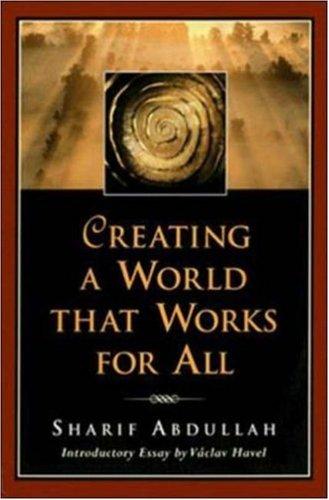
I'm still thinking about the message of  Occupy Wall Street; still yearning for a way forward that will lead to a more peaceful, equitable, and environmentally sustainable world that will benefit and meet the needs of all. I read several thought-provoking posts on this subject at Commonway Praxis, a blog written by Dr. Sharif Abdullah.  The following quote is from Dr. Abdullah's book, Creating A World That Works For All:
"We live in a world that works for only a few.  The problem  is exclusivity: the fundamental belief that we are separate  from one another.  All beings, all things, are One.  Our lives  are inextricably linked one to another.  Because of this, we cannot wage war against anything or  anyone without  waging war against ourselves.    Therefore, we are obliged to treat all beings the way we want to be treated.  There are no 'enemies' - all beings are expressions of the Sacred and must  be treated as such.  Some being cause pain to others; this does not meant that they are enemies.   Some beings are food for others; this is all the more reason to treat them as sacred.  Once we understand that we are interconnected, we have the responsibility to create a world that works for all."
"With this as our goal, the next question is obvious: how do we achieve it?  How do we avoid sinking into despair or cynicism?  And how do we avoid dabbling in utopian fantasies or engaging in 'pie-in-the-sky' religiosity?  In fact, we can change this world right now by shifting our consciousness and our values from a foundation of exclusivity to one of inclusivity. This shift in consciousness is the core of the world's major religions.  The essence of the moral code they urge upon us is inclusivity:

         What is hateful to you, do not do to others.  ~RABBI HILLEL

         Do not hurt others with that which hurts yourself.    ~ BUDDHA

         Do unto others whatever you would have them do unto you.  ~ JESUS
                   None of you is a believer until you love for your neighbor what you love for 
                    yourself.  ~ MUHAMMAD                                                                                                              
"Considering the clarity, simplicity, and consistency of these statements, one has to wonder what it is about the message of inclusivity that makes it nearly impossible for people to either comprehend or implement.  Why are there Jews, Buddhists Christians, Muslims, and many others around the world who are killing their fellow men and women when their traditions call for peace, nonviolence, and inclusivity?"
For me, the HOW is the missing piece that I've been searching for.  How do we implement the spiritual truths found in all the world's religions?  How do we put our spiritual teachings into concrete practice in our daily lives?  How do we embody the Divine and bring the Kingdom of Heaven down to this Earth that we all live on? 

Well, I'm very excited about a tool I recently learned about that's really answering the big HOW question for me.  Non Violent Communication, developed by Dr. Marshall Rosenberg, is much more than a communication method but a practical way to connect with "others" and live with Love toward all - beginning with our interpersonal relationships and expanding to peace at the global level. It is a way to practice the connections that make violence both inappropriate and impossible.  Below is the first in a series of Youtube videos filmed during a one-day introductory workshop in which Marshall Rosenberg teaches the basics of Non Violent Communication.  Altogether, more than three hours of this workshop can be viewed free of charge! 


Dr. Rosenberg's book is Non Violent Communication: A Language of Life.  Many additional resources can also be found online at the Center for Non Violent Communication and the NVC Academy.

By the way, PuddleDancer Press, the premier publisher of Nonviolent Communication related books, has recently donated hundreds of books on Non Violent Communication to various Occupy Wall Street libraries.                                                                              


Sunday, October 30, 2011

BUILDING A CARING ECONOMY: CARING PAYS!

Occupy Wall Street and the current economic condition of our country leave me wondering: Is there a way BEYOND left vs. right, Republican vs. Democrat, capitalist vs. socialist?  Is there a way FORWARD that will lead to a more peaceful, equitable, and environmentally sustainable world that will benefit and meet the needs of all?  

Well, I was delighted to discover Riane Eisler, who has devised a very sensible economic plan - a plan which demonstrates how caring for humans and the planet can actually be profitable.  Dr. Eisler (who is a social scientist, attorney, and internationally known author who is included in the award-winning book Great Peacemakers as one of 20 leaders for world peace, along with Mahatma Gandhi, Mother Teresa, and Martin Luther King) talks about her book The Real Wealth of the Nations and the need for an economics of caring in the following video:


Dr. Eisler's "Full Spectrum Job Creation Proposal: The Roadmap to a New Caring Economy,"  was submitted to President Obama in 2009 and can be read in it's entirety here.  Visit Dr. Eisler's websites here, here, and here for a wealth of additional material and to discover ways you can become involved.